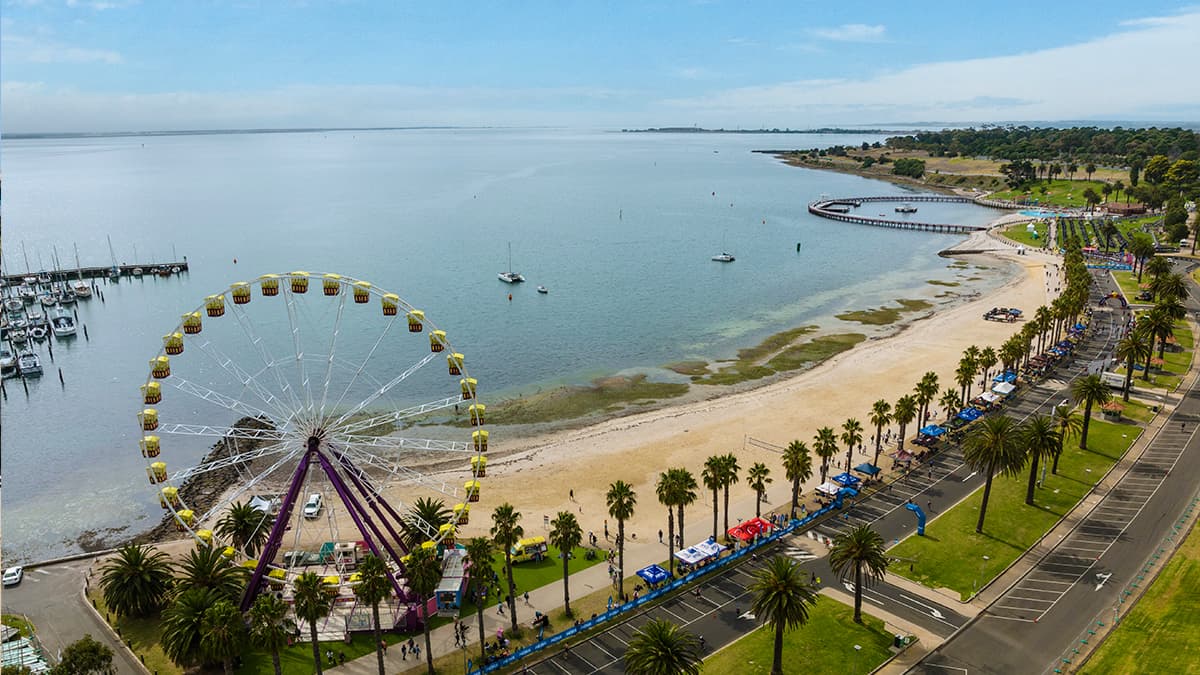
IRONMAN 70.3 GeelongTraining Plan & Race Guide 2027
Geelong, AustraliaMarch 21, 202770.3 mi — Half Distance2 min readPublished July 13, 2026
Share
01·Course Characteristics
The tactical challenge of Geelong
Success in Geelong hinges on handling unpredictable bay winds, staying aero against brutal head/crosswinds, and surviving a punchy, zero-shade waterfront run.
Climate
22°C
Peak air · water 18°C · late March
Conditions
Windy
Unpredictable gusts · morning fog · high humidity
Elevation
412 m
Bike gain · rolling · short 6.5% climb
Difficulty
5.5 / 10
Officially rolling, but strong coastal winds and steep, exposed run hills present a deceptive sting in the tail.
You're on track
You have 22 weeks until race day.
Build your 16-week plan for IRONMAN 70.3 Geelong — we'll start it on Nov 29, 2026, free to preview.
A single-loop bay swim featuring a rolling beach start in the relatively protected waters of Corio Bay. Morning winds can create a choppy surface, and the first 800 meters head straight east into the rising sun.
02
Bike
Exposed Portarlington Loops
Geelong-Portarlington Road
DISTANCE
90 km
LOOPS
Two-loop
ELEVATION
412 m
SURFACE
Smooth & rough sections
WIND
High head/crosswinds
A two-loop course featuring a technical start through Eastern Park before hitting the wide, smooth Geelong-Portarlington Road. Be prepared for a rougher segment on Point Henry Road, a brief 6.5% climb at the 20km mark, and punishing return headwinds.
03
Run
Undulating Waterfront Path
Corio Bay Waterfront
DISTANCE
21.1 km
LOOPS
2.5 loops
ELEVATION
97-200 m
SURFACE
Paved & boardwalk
SHADE
Virtually none
A multi-lap run along the scenic waterfront that begins with a grueling 600m uphill false-flat right out of transition. You will tackle a steep climb on each lap under highly exposed, sun-drenched conditions.
03·AVG beginners' Training Timeline
From zero to the finish line
16 weeks
This 16-week arc is tailored to the wind and rolling hills of Geelong. It begins by securing your aerobic base, transitions to building muscular endurance in the aero position, and finishes with race-specific simulation of the punchy run hills and bay conditions, ensuring you cross the line with confidence.
Today · WK 0Race Day
WK 1–5
Aerobic Base & Durability
Build foundational aerobic capacity and resilience to handle the volume of three disciplines.
WK 6–10
Strength & Aero Endurance
Develop sustained power in the aero position and build resistance against strong winds.
WK 11–14
Race-Specific Build
Simulate course challenges with transition runs starting on climbs and high-intensity headwind pacing.
WK 15–16
Taper & Sharpen
Reduce volume to shed fatigue while executing short, race-pace efforts to stay sharp.
Adapts to your fitness, schedule & recovery every week.
Prepare for a chilly, foggy morning followed by clear, sunny skies and high UV. Leverage the dense run aid stations for ice and sponges to lower your core temperature, as the run path offers virtually no shade.
Fuel & hydration
The cool coastal winds on the bike can mask sweat loss, making structured hydration critical. Plan to consume consistent fluids and target 60-90g of carbs per hour, utilizing the four bike aid stations spaced roughly 20-25km apart.
Pacing
Conserve energy during the fast, tailwind-assisted outbound bike legs so you can fight the brutal return headwinds. Save an extra gear for the steep run hills and the 600m false-flat immediately exiting transition.
Gear & logistics
Bring tinted or mirrored goggles to combat the severe morning sun glare during the swim. Since the transition at Steampacket Gardens is highly compact and operates without bags, arrive early to set up your gear and memorize your rack landmarks.
Frequently Asked Questions
What is the water temperature and wetsuit policy for the IRONMAN 70.3 Geelong swim?
The water temperature in Corio Bay typically averages around 18°C (64°F), which makes the swim highly likely to be wetsuit legal. Because the first 800 meters of the single-loop swim heads directly east into the rising sun, you should wear tinted goggles to prevent glare and make sighting easier.
How hard is the IRONMAN 70.3 Geelong bike course?
The bike course is moderately difficult, featuring a two-loop, 90km layout with 412 meters (1,351 feet) of total elevation gain. While the wide, smooth tarmac on Geelong-Portarlington Road allows you to settle into a fast aero rhythm, you must contend with a technical start through Eastern Park, a short 6.5% climb at the 20km mark, and highly exposed sections prone to grueling head- and crosswinds.
What is the run course profile like for IRONMAN 70.3 Geelong?
The 21.1km run consists of a 2.5-loop, undulating path along the Corio Bay waterfront that mixes paved paths and boardwalks. It is a mentally and physically demanding course with virtually no shade, featuring a 600m uphill false-flat right out of transition and a steep, punchy hill that you must climb during each of the full laps.
Where are the aid stations located on the IRONMAN 70.3 Geelong bike course?
To help you manage your hydration, on-course bike aid stations are strategically placed at approximately 4.6 km, 25 km, 49.8 km, and 70.2 km. Even if the cool ocean wind masks your sweat rate, it is critical to stick to a disciplined drinking strategy across these four points to prevent dehydration.
How does transition work at IRONMAN 70.3 Geelong?
Transition is located on the grassy lawns of Steampacket Gardens and operates as a traditional setup without a gear bag system, meaning all your equipment is placed directly next to your bike. Because the transition area is highly compact and congested, you should take careful landmark notes of your specific rack location before the race starts.
Your Personalized Plan
Stop guessing your intervals. Train for this course.
FE26 builds your plan around your Strava data, your real schedule, and the exact demands of IRONMAN 70.3 Geelong— then adapts every week to how you actually perform.