IRONMAN 70.3 MuncieTraining Plan & Race Guide 2026
Muncie, United StatesJuly 11, 202670.3 mi — Half Distance2 min readPublished June 17, 2026Updated July 23, 2026
Share
01·Course Characteristics
Midwestern Heat and Highway Speed
A blisteringly fast, aerodynamic bike course is tempered by a warm, likely non-wetsuit swim and a deceptively rolling, completely exposed half marathon in stifling mid-July humidity.
Climate
30°C
Peak air · water 25-26.6°C · heat index up to 38°C
Conditions
Exposed
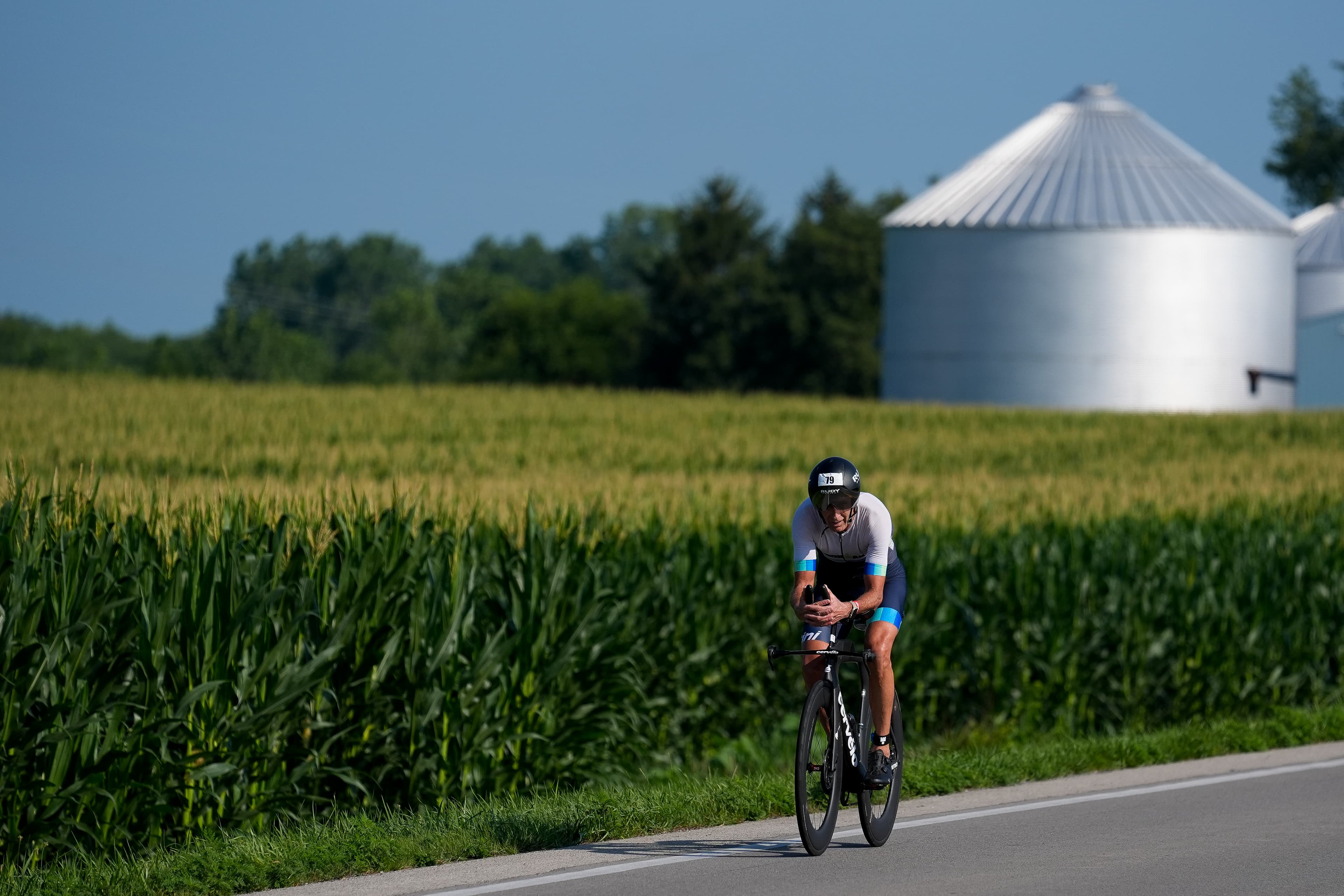
Open Indiana cornfields · high humidity · no run shade
Elevation
305 m
Bike gain · rolling reservoir roads · false flats on US-35
Difficulty
6.5 / 10
While the bike is fast and flat, the non-wetsuit reservoir swim and stifling mid-July heat index up to 38°C on the exposed run elevate the challenge.
This edition has passed
Training for a future IRONMAN 70.3 Muncie?
Registration for the next edition opens on a rolling basis. Start building your base now and we'll size a full plan the moment a new date is set.
A calm, single-loop swim in a freshwater reservoir with negligible currents and a rolling self-seeded start. The final stretch heads east directly into the blinding morning sun. A long transition corridor of about 530 meters awaits you on the exit.
02
Bike
Cornfields & Highways
US-35 & Reservoir Country Roads
DISTANCE
90 km
ELEVATION
305 m
SURFACE
Asphalt & chip-seal
LOOPS
Out-and-back
WIND
High exposure
An incredibly fast course starting with 10 km of rough, rolling country roads before transitioning to the glass-smooth, closed US-35 highway. Expect long, aerodynamic straightaways with minor 1 to 3 percent false flats, highly exposed to strong headwinds or crosswinds through open cornfields.
03
Run
The Heat Index Run
South Reservoir Country Roads
DISTANCE
21.1 km
ELEVATION
140 m
SHADE
Minimal
PEAK TEMP
Up to 38°C heat index
LOOPS
Single-loop
A rolling out-and-back course tracing the south side of the reservoir on paved roads. With virtually zero shade, the midday sun reflects off the black asphalt, creating stifling heat. A brutal 7 percent grade climb awaits you just before entering the finisher's chute.
03·AVG beginners' Training Timeline
From zero to the finish line
16 weeks
This 16-week program builds the sustained aerobic power needed to hold your aero tuck on US-35 and the high-durability running mechanics required for Muncie's rolling, exposed run. Heat exposure is phased in progressively so you can handle the extreme July humidity.
Today · WK 0Race Day
WK 1–5
Aerobic Base & Heat Prep
Build a strong aerobic foundation and initiate sweat rate adaptations.
WK 6–10
Strength & Aero Aerobic Power
Develop low-cadence climbing strength and sustained aerodynamic positioning.
WK 11–14
Race-Specific Build & Heat Acclimation
Execute high-volume key sessions in simulated heat with race-pace pacing.
WK 15–16
Taper & Sharpen
Reduce training volume to shed fatigue while maintaining race-pace sharpness.
Adapts to your fitness, schedule & recovery every week.
Expect midday air temperatures to reach 30°C with high humidity pushing the heat index close to 38°C. Utilize every aid station for cold water, ice, and wet sponges to actively lower your core body temperature on the completely exposed run.
Fuel & hydration
High sweat rates require proactive hydration and elevated sodium intake on the flat bike to prepare for the run. Aim for 60 to 90 grams of carbohydrates per hour, transitioning to easily digestible liquids, gels, and chews as heat fatigue sets in.
Pacing
Do not over-torque on the fast, flat US-35 highway; hold back slightly to offset the heavy heat tax of the run. Save a matches-in-the-tank reserve to conquer the deceptively rolling country roads and the steep 7 percent climb at the end.
Gear & logistics
Arrive at the reservoir by 4:30 AM to secure restricted parking. Wear dark, mirrored goggles for the blinding swim return, use deep-section wheels only if comfortable with crosswinds, and pack mud protection like trash bags for transition in case of rain.
Frequently Asked Questions
What is the water temperature and wetsuit policy for the IRONMAN 70.3 Muncie swim?
The water temperature in Prairie Creek Reservoir typically averages between 77°F and 80°F (25°C to 26.6°C), meaning the swim is frequently non-wetsuit legal or wetsuit optional (disqualifying you from age-group awards). Sighting is very straightforward on the calm, single-loop course, but you should bring dark or mirrored goggles to combat the rising sun as you swim back toward the beach. Additionally, wear a pair of throwaway flip-flops for the long, rocky walk from transition to the swim start.
How hard is the IRONMAN 70.3 Muncie bike course?
The bike course is relatively fast with about 1,000 feet of total elevation gain and no major climbs, but it presents unique challenges. You will navigate rolling, rough 'chip and seal' country roads for the first six miles before transitioning to the ultra-smooth, closed-to-traffic asphalt of US-35 where you can lock into an aero tuck. The main obstacles are the high wind exposure across open cornfields—often causing headwinds or crosswinds on the way out—and gradual false flats of 1 to 3 percent.
What is the run course like at IRONMAN 70.3 Muncie?
The run is a single-loop out-and-back course with approximately 460 feet of elevation gain winding around the south side of Prairie Creek Reservoir. It is deceptively rolling, paved with black asphalt, and highly exposed to the sun with virtually no shade. You will need to pace yourself carefully, as a steep climb with a sharp 7 percent grade awaits you just before you turn into the finish chute.
How should I manage nutrition and hydration for the hot conditions at Muncie?
With mid-July air temperatures reaching 86°F (30°C) and a humidity-driven heat index that can exceed 100°F (38°C), aggressive hydration and electrolyte management are critical. You should take advantage of the flat bike course to easily digest fuel and consume high levels of sodium and fluids to prepare for the run. Once on the run, transition to easily absorbable liquids, gels, and chews, and use the cold water, ice, and ice sponges at every aid station to keep your core temperature down.
What are the parking and morning logistics for IRONMAN 70.3 Muncie?
Because only two roads access Prairie Creek Reservoir, parking is highly restricted and prone to gridlock, making it essential to arrive by 4:30 AM before transition opens at 5:00 AM. If rain is in the forecast, the grass parking and transition areas can become incredibly muddy, so pack trash bags or mats to protect your gear. You should also prepare for a long transition walk, as T1 requires a 1/3-mile run up a fenced corridor from the water.
Your Personalized Plan
Stop guessing your intervals. Train for this course.
FE26 builds your plan around your Strava data, your real schedule, and the exact demands of IRONMAN 70.3 Muncie— then adapts every week to how you actually perform.