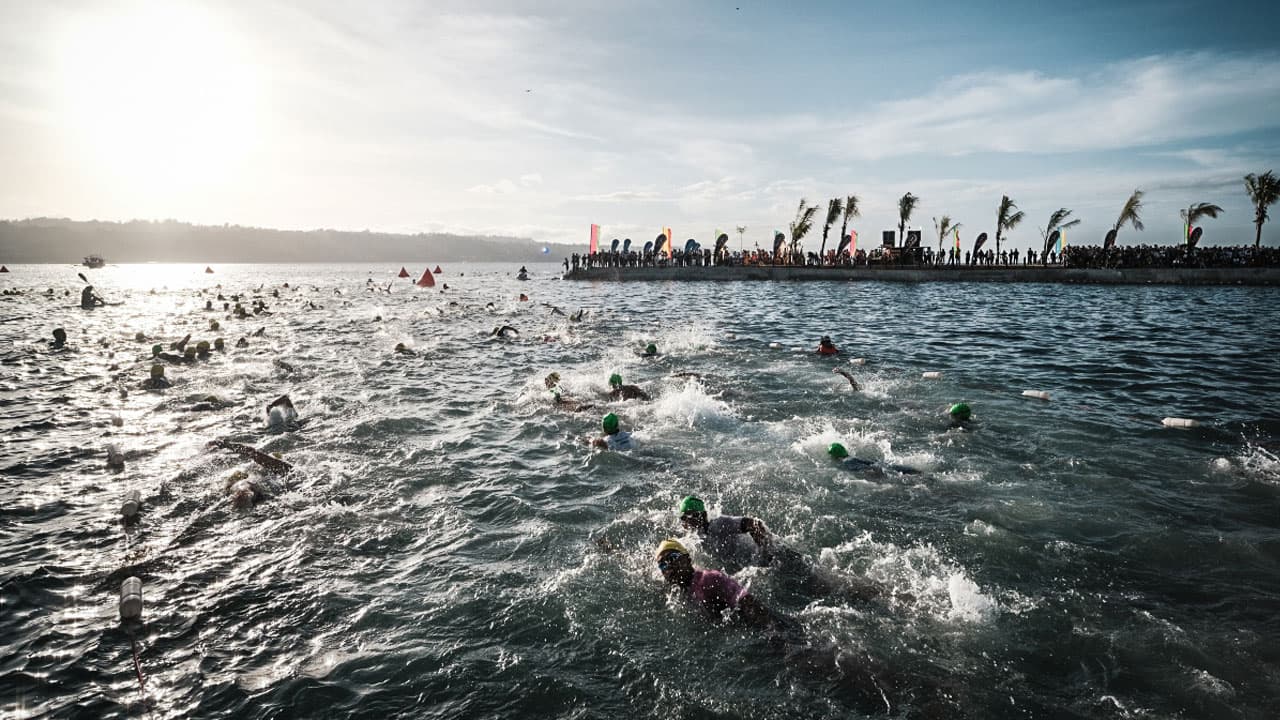
A single-loop clockwise swim in the calm sea waters of Talomo Bay, framed by views of Mt. Apo. The course features a rolling start beginning at 6:30 AM.
02
Bike
Coastal Road Loops
Davao City Coastal Road
DISTANCE
90 km
LOOPS
3 loops
ELEVATION
283 m
TERRAIN
Flat with false flats
WIND
Strong coastal winds
A flat, fast, three-loop course starting along the Davao City Coastal Road that crosses the newly completed Bucana Bridge. Strong coastal winds and technical turnarounds at the roundabouts require constant focus, while high athlete density demands strict drafting vigilance.
03
Run
MacArthur Highway Run
Bago Esplanade to MacArthur Highway
DISTANCE
21.1 km
LOOPS
2 loops
ELEVATION
Flat at sea level
SHADE
Almost no shade
PEAK TEMP
31-34°C
A fully paved, two-loop counter-clockwise run from Bago Esplanade toward MacArthur Highway. This flat, seaside course offers virtually no shade, exposing you to peak tropical heat.
03·AVG beginners' Training Timeline
From zero to the finish line
16 weeks
This 16-week progression targets the unique thermal and aerodynamic demands of Davao. Because the course is flat but physiologically brutal, we emphasize steady-state endurance and progressive heat acclimation to ensure your cardiorespiratory system can handle the high tropical humidity on race day.
Today · WK 0Race Day
WK 1–5
Aerobic Base & Heat Prep
Build a strong aerobic foundation while starting early metabolic efficiency training.
WK 6–10
Flat Course Aerobic Power
Develop sustained aerodynamic endurance and high-cadence non-wetsuit swimming efficiency.
WK 11–14
Specific Heat & Wind Build
Introduce course-specific heat adaptation protocols and steady state pacing in windy conditions.
WK 15–16
Taper & Strategy Precision
Reduce training volume to shed fatigue while locking in hydration and pacing strategies.
Adapts to your fitness, schedule & recovery every week.
Expect extreme tropical humidity and peak daytime temperatures between 32°C and 34°C. Prioritize aggressive external cooling with ice and water at every aid station, and protect your skin with high-SPF waterproof sunscreen.
Fuel & hydration
Sweat rates will be exceptionally high due to the climate, requiring a targeted high-sodium electrolyte strategy. Secure your frame-mounted bottle cages tightly, as bumpy urban road joints are notorious for launching rear-saddle bottles.
Pacing
Start the flat bike conservatively to manage your core temperature before the intense midday heat. On the high-density, three-loop bike course, maintain the mandatory twelve-meter drafting zone and save energy for the exposed, shade-free run.
Gear & logistics
Fly into Francisco Bangoy International Airport and secure lodging near Ecoland or Bago Aplaya. Choose a deep-section front wheel carefully due to coastal winds, and prepare a strict non-wetsuit swim kit.
Frequently Asked Questions
What is the water temperature and wetsuit policy for the IRONMAN 70.3 Davao swim?
The water temperature in Talomo Bay typically ranges from warm levels of 26°C to 28°C (79°F to 82°F), making the swim strictly non-wetsuit legal. You will navigate a 1.9 km, 1-loop, clockwise rectangular course starting at the Bago Aplaya Esplanade. The swim begins with a rolling start at 6:30 AM, offering calm sea waters and scenic views of Mt. Apo.
How hard is the IRONMAN 70.3 Davao bike course?
The 90 km bike course is flat to rolling with only 283 meters (approx. 928 feet) of total elevation gain, making it physically geared toward fast times. However, it is a highly technical 3-loop, counter-clockwise course that features strong coastal winds, sharp roundabouts, and a high athlete density requiring strict drafting vigilance. You should also prepare for minor false flats when crossing the newly completed Bucana Bridge.
What are the weather conditions like for IRONMAN 70.3 Davao?
You should prepare for a very demanding, hot, and humid race day, as this event is widely considered one of the toughest stops on the Philippine triathlon circuit due to intense sun exposure. Typical temperatures range from a morning low of 24°C (75°F) to a sweltering daytime high of 32°C to 34°C (90°F to 93°F). Managing the tropical humidity and peak midday heat will be the deciding factor for your race.
What is the run course layout and terrain for IRONMAN 70.3 Davao?
The run is a completely paved, flat, 21.1 km course consisting of two counter-clockwise loops starting from the Bago Esplanade transition area. The route takes you along the Davao City Coastal Road and MacArthur Highway, turning around near the JFI Building and the Bago Aplaya Esplanade. Because the course offers almost no shade, you will be fully exposed to peak tropical temperatures reaching up to 34°C (93°F).
How should I plan my nutrition and hydration for the IRONMAN 70.3 Davao bike leg?
Because of the extreme heat and humidity, you must prioritize high-sodium electrolyte hydration, such as the event's partner drink Ion+ Advanced Electrolyte, alongside your carbohydrate intake. To prevent losing your nutrition, use frame-mounted bottle cages rather than rear-saddle setups. The urban road joints and bumpy segments on the course can easily launch bottles from behind your saddle.
Your Personalized Plan
Stop guessing your intervals. Train for this course.
FE26 builds your plan around your Strava data, your real schedule, and the exact demands of IRONMAN 70.3 Davao Philippines— then adapts every week to how you actually perform.