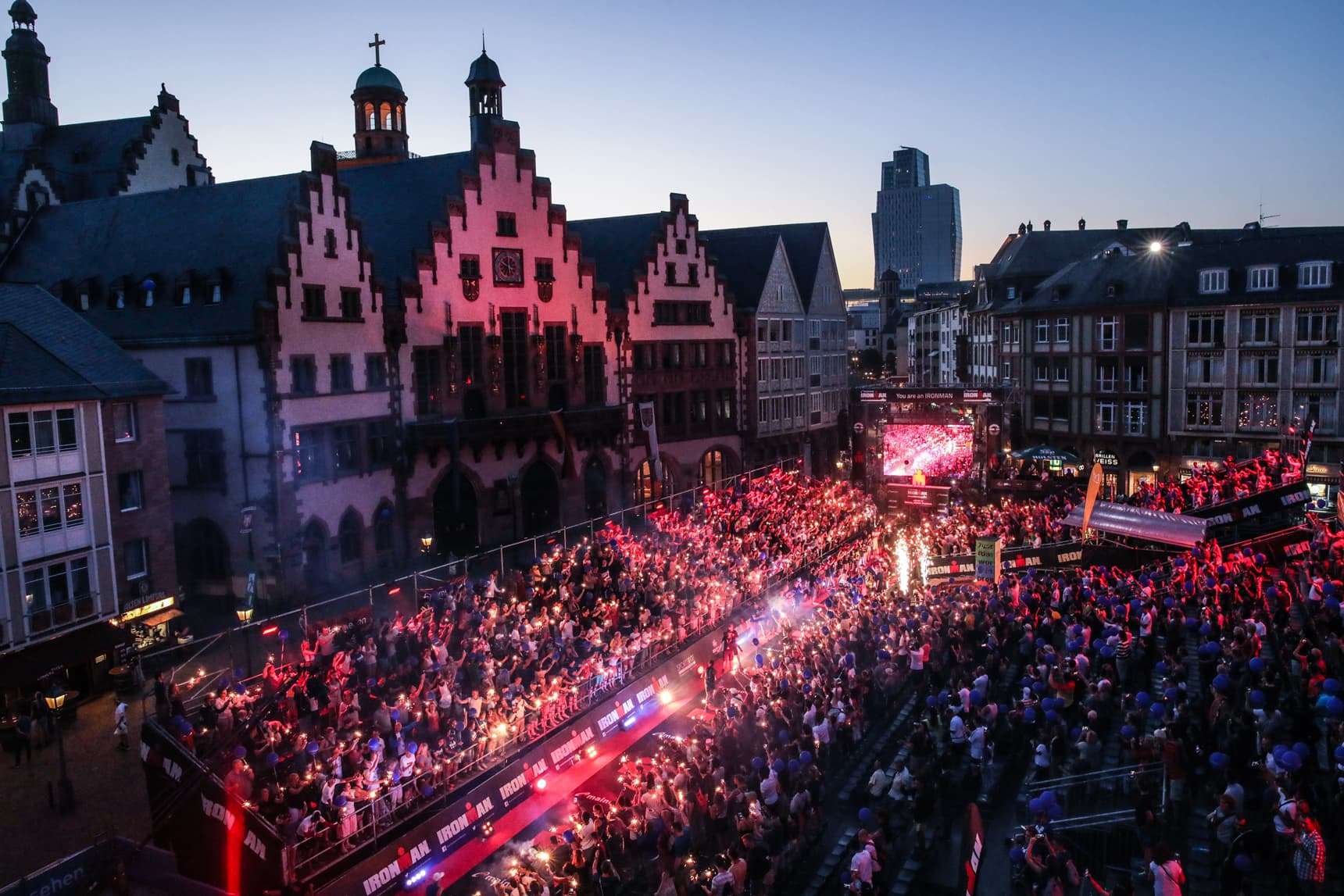
Frankfurt, GermanyJune 28, 2026140.6 mi — Full Distance2 min readPublished July 13, 2026
Share
01·Course Characteristics
The measure of IRONMAN Frankfurt
A legendary European Championship course that demands ultimate discipline. Deceptive rolling hills in the Taunus region and baking afternoon heat along the Main River will test your pacing and thermal management to their absolute limits.
Climate
32°C
Peak air · water 18-22°C · late June
Conditions
Exposed
River sun exposure · zero swim current · rolling bike
Elevation
1,600 m
Rolling bike loops · 95 m run gain
Difficulty
7 / 10
Deceptively tough due to 1,600m of undulating bike climbing, frequent rhythm shifts, and a hot, completely unshaded run.
This edition has passed
Training for a future IRONMAN Frankfurt?
Registration for the next edition opens on a rolling basis. Start building your base now and we'll size a full plan the moment a new date is set.
A calm, clear forest lake swim south of central Frankfurt. It features a rolling-start format and a brief sandy run across the beach for the Australian exit before diving in for loop two.
02
Bike
Taunus Hills Rollercoaster
Langener Waldsee to Frankfurt Loops
DISTANCE
180 km
LOOPS
2 loops
ELEVATION
1,600 m
TERRAIN
Rolling hills
SURFACE
Smooth asphalt
WIND
Occasional crosswind
After departing T1, head north to Frankfurt and complete two rolling loops through the Taunus hills. The signature test is 'Der Hammer' in Bad Vilbel, a short but brutally steep 20% climb lined with spectators.
03
Run
The Main River Heat
Main River Banks to Römerberg
DISTANCE
42.2 km
LOOPS
4 loops
ELEVATION
95 m
SURFACE
Paved asphalt
SHADE
Virtually none
PEAK TEMP
28-32°C
A flat and lightning-fast four-loop out-and-back course along both banks of the Main River, crossing major bridges twice per lap. High spectator density provides immense energy, but the asphalt has zero shade.
03·AVG beginners' Training Timeline
From zero to the finish line
24 weeks
This 24-week plan is customized to prepare your body for the physical demands of Frankfurt. By building hill-climbing power during the second phase and integrating race-intensity bricks during the peak weeks, you will develop the exact pacing discipline and thermal efficiency required to survive the hot marathon.
Today · WK 0Race Day
WK 1–6
Aerobic Foundation
Build baseline aerobic capacity and technique in all three disciplines.
WK 7–12
Strength & Hill Power
Develop bike strength and muscular endurance for the Taunus hills.
WK 13–18
Race-Specific Build
Increase volume, practice high-carb fueling, and integrate brick workouts.
WK 19–21
Peak & Heat Prep
Execute race-pace simulations and start targeted heat-adaptation training.
WK 22–24
Taper & Peak
Shed fatigue while preserving intensity to arrive fresh on the start line.
Adapts to your fitness, schedule & recovery every week.
Expect a cool 14-16°C start at the lake, but prepare for 28-32°C during the run. Actively utilize every single aid station for ice and wet sponges to lower your core temperature before heat exhaustion sets in.
Fuel & hydration
Front-load your nutrition on the bike when digestion is easiest, targeting 80-100g of carbohydrates per hour. Due to high afternoon heat, execute an aggressive hydration and high-sodium replacement strategy on the bike and run.
Pacing
Protect your legs on the rolling bike course by riding conservatively and capping your effort on the 20% Heartbreak Hill. An aggressive bike leg on these rhythm-changing hills will guarantee a massive fade during the marathon.
Gear & logistics
This is a split-transition race. You must check your bike in at T1 (the lake) the day before the race, and utilize the official race shuttles from downtown Frankfurt to the swim start on race morning.
Frequently Asked Questions
What is the water temperature and wetsuit rule for the IRONMAN Frankfurt swim?
The swim takes place in Langener Waldsee, where water temperatures typically range between 18°C and 22°C (64.4°F to 71.6°F). This means the swim is usually wetsuit-legal for age-group athletes, though it can occasionally be borderline if the lake warms up. You should prepare for both wetsuit and non-wetsuit scenarios just in case.
How hard is the IRONMAN Frankfurt bike course elevation?
The 180 km bike course is moderately challenging, featuring between 1,600 and 1,800 meters (5,249 to 5,905 feet) of total elevation gain through the Taunus region. While the asphalt is smooth and fast, the rolling hills and the steep 20% gradient of 'Der Hammer' (Heartbreak Hill) require a highly disciplined pacing strategy. It is more demanding than flat courses like Hamburg, but less extreme than mountain races like Lanzarote.
What are the transition logistics for the split transition at IRONMAN Frankfurt?
Because this is a split-transition race, T1 is located 20 km south of the city at Langener Waldsee, while T2 and the finish line are situated in downtown Frankfurt. You must check your bike into T1 at the lake on the day before the race. On race morning, it is highly recommended to take the official event shuttles from central Frankfurt directly to the swim start.
What is the run course like and how hot does it get at IRONMAN Frankfurt?
The marathon consists of four flat, fast loops along the banks of the Main River, totaling only about 95 meters (312 feet) of elevation gain. However, the paved course has virtually no shade, exposing you to high afternoon temperatures that often reach 28°C to 32°C (82°F to 90°F). To manage this intense heat, you must aggressively use the aid stations for ice and wet sponges while keeping up with your hydration.
What should my nutrition and hydration strategy be for IRONMAN Frankfurt?
With afternoon temperatures frequently exceeding 30°C (86°F), you should target a high carbohydrate intake of 80 to 100 grams per hour early on the bike when digestion is easiest. Combine this with aggressive sodium and fluid replacement to counteract heavy sweating. Once on the run, transition to easily digestible simple sugars like gels and sports drinks to prevent heat-induced gastrointestinal distress.
Your Personalized Plan
Stop guessing your intervals. Train for this course.
FE26 builds your plan around your Strava data, your real schedule, and the exact demands of IRONMAN Frankfurt— then adapts every week to how you actually perform.