IRONMAN 70.3 CairnsTraining Plan & Race Guide 2026
Cairns, AustraliaJune 14, 202670.3 mi — Half Distance2 min readPublished April 22, 2026Updated July 4, 2026
Share
01·Course Characteristics
The Trial of Coral Coast
Conquering Cairns requires managing a choppy ocean swim, a grinding headwind on the coastal highway return, and an exposed, humid run along the Esplanade.
Climate
26°C
Peak air · water 24-26°C · mid-June dry season
Conditions
Humid
Southeasterly winds · high UV · murky ocean water
Elevation
600 m
Rolling bike course · pinchy climbs · flat run
Difficulty
6.5 / 10
Moderate to challenging due to choppy saltwater, persistent headwind on the bike, and high tropical humidity on the run.
This edition has passed
Training for a future IRONMAN 70.3 Cairns?
Registration for the next edition opens on a rolling basis. Start building your base now and we'll size a full plan the moment a new date is set.
A single-loop ocean swim starting at sandy Palm Cove Beach. Expect choppy sea conditions driven by the southeasterly trade winds, murky water visibility, and early morning sun glare sighting challenges on the outward legs.
02
Bike
Captain Cook Coastal Route
Palm Cove to Cairns CBD
DISTANCE
90 km
LOOPS
1
ELEVATION
600 m
TERRAIN
Rolling coastal highway
SURFACE
Coarse chip asphalt
WIND
Strong southeasterly
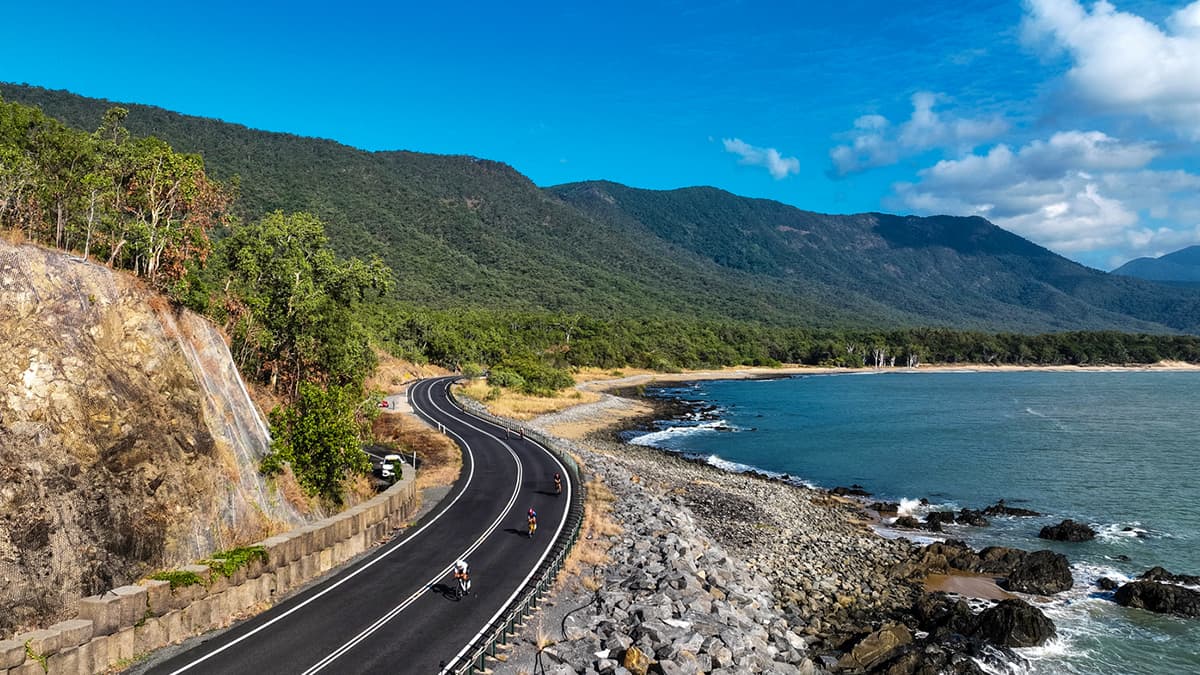
This scenic point-to-point course features rolling terrain and short, pinchy climbs, peaking at Rex's Lookout. The primary challenge is the grueling 15-20 km/h southeasterly headwind during the southern return leg past Palm Cove and through exposed farmlands.
03
Run
Esplanade Boardwalk Loops
Cairns Esplanade and Boardwalk
DISTANCE
21.1 km
LOOPS
2
ELEVATION
25 m
SURFACE
100% paved/concrete
SHADE
Partially exposed
PEAK TEMP
28-29°C
A flat, fast 2-loop anti-clockwise run along the Cairns Esplanade. While flat, the route is highly exposed to the afternoon sun, with temperatures regularly peaking near 29°C alongside high tropical humidity.
03·AVG beginners' Training Timeline
From zero to the finish line
16 weeks
This 16-week plan focuses on building raw aerobic capacity first, then prepares you specifically for Cairns' unique challenges: battling a 15-20 km/h headwind on the bike and surviving a humid, sun-drenched run.
Today · WK 0Race Day
WK 1–5
Aerobic Base & Choppy Swim Prep
Build your engine and practice breathing techniques for rough open water.
WK 6–10
Strength & Headwind Endurance
Develop cycling torque to battle coastal head winds and adapt to coarse chip asphalt.
WK 11–14
Heat Tolerance & Brick Run Build
Introduce heat acclimation and long brick runs to handle high humidity on the Esplanade.
WK 15–16
Logistics Planning & Taper
Reduce volume while sharpening pace and preparing for the split-transition setup.
Adapts to your fitness, schedule & recovery every week.
Expect humid conditions peaking at 28-29°C with high UV. Actively use the run aid stations spaced every 2km to grab ice, stuffing it into your tri-suit and hat to keep your core temperature down.
Fuel & hydration
Pre-load electrolytes before the race to combat tropical sweat losses. Target 60-90 grams of carbohydrates per hour on the bike, utilizing the four aid stations placed roughly every 18-20km.
Pacing
Do not over-cook the northern, scenic leg of the bike; save energy for the brutal headwind on the return southern leg. Keep your run pace conservative during the first lap of the Esplanade to survive the humid, exposed boardwalk.
Gear & logistics
This is a split-transition race, so stay near Cairns CBD and book the official morning shuttle to Palm Cove. Pack your bike and bike gear in your blue bag for T1 at Palm Cove, and your run gear in your red bag for T2 in Cairns.
Frequently Asked Questions
What is the water temperature and wetsuit rule for the IRONMAN 70.3 Cairns swim?
The ocean water temperature at Palm Cove typically averages between 24°C and 26°C (75°F to 79°F). Because of this, wetsuits are generally optional for age-group athletes subject to the 24.5°C rule, while professional athletes are usually prohibited from wearing them. You should prepare for a potentially non-wetsuit, choppy saltwater swim with murky visibility.
How hard is the bike course at IRONMAN 70.3 Cairns?
The 90km bike course is rated as moderate to challenging, featuring about 600 meters (1,968 to 2,066 feet) of total elevation gain with short, pinchy climbs, including Rex's Lookout. While the coastal road surface is well-maintained coarse chip asphalt, your biggest tactical challenge will be fighting a relentless southeasterly headwind of 15–20 km/h on the return leg to Cairns. Proper pacing and targeting 60-90 grams of carbohydrates per hour will be key to saving your legs.
How do logistics work for the split transition at IRONMAN 70.3 Cairns?
Because T1 is located 25km north in Palm Cove and T2 is in the Cairns CBD, you must split-pack your gear. You will rack your bike and blue bike gear bag at T1 on Saturday, and check your red run gear bag at T2 in Cairns CBD. To make race morning seamless, it is highly recommended to stay near the Cairns CBD and pre-book the official event shuttle to transport you to the swim start.
What is the run course profile and climate like for IRONMAN 70.3 Cairns?
The 21.1km run is a flat, two-loop course along the paved Cairns Esplanade and boardwalk, with only about 25 meters of elevation gain. However, it can become a battle of attrition as afternoon temperatures often peak at 28°C–29°C (82°F–84°F) under direct sunlight with high tropical humidity. You should take full advantage of the aid stations every 2km to grab water, electrolytes, and ice to stuff into your tri-suit and hat.
What are the typical weather conditions for IRONMAN 70.3 Cairns in June?
June brings the dry winter season to Tropical North Queensland, meaning you will experience very low rainfall but high tropical humidity. Expect race day air temperatures to range from an overnight low of 18°C (64°F) to an afternoon high of 26°C to 29°C (79°F to 84°F). Strong southeasterly trade winds of 15–20 km/h (9–13 mph) and a high UV index are major factors, making sun protection and wind management critical.
Your Personalized Plan
Stop guessing your intervals. Train for this course.
FE26 builds your plan around your Strava data, your real schedule, and the exact demands of IRONMAN 70.3 Cairns— then adapts every week to how you actually perform.