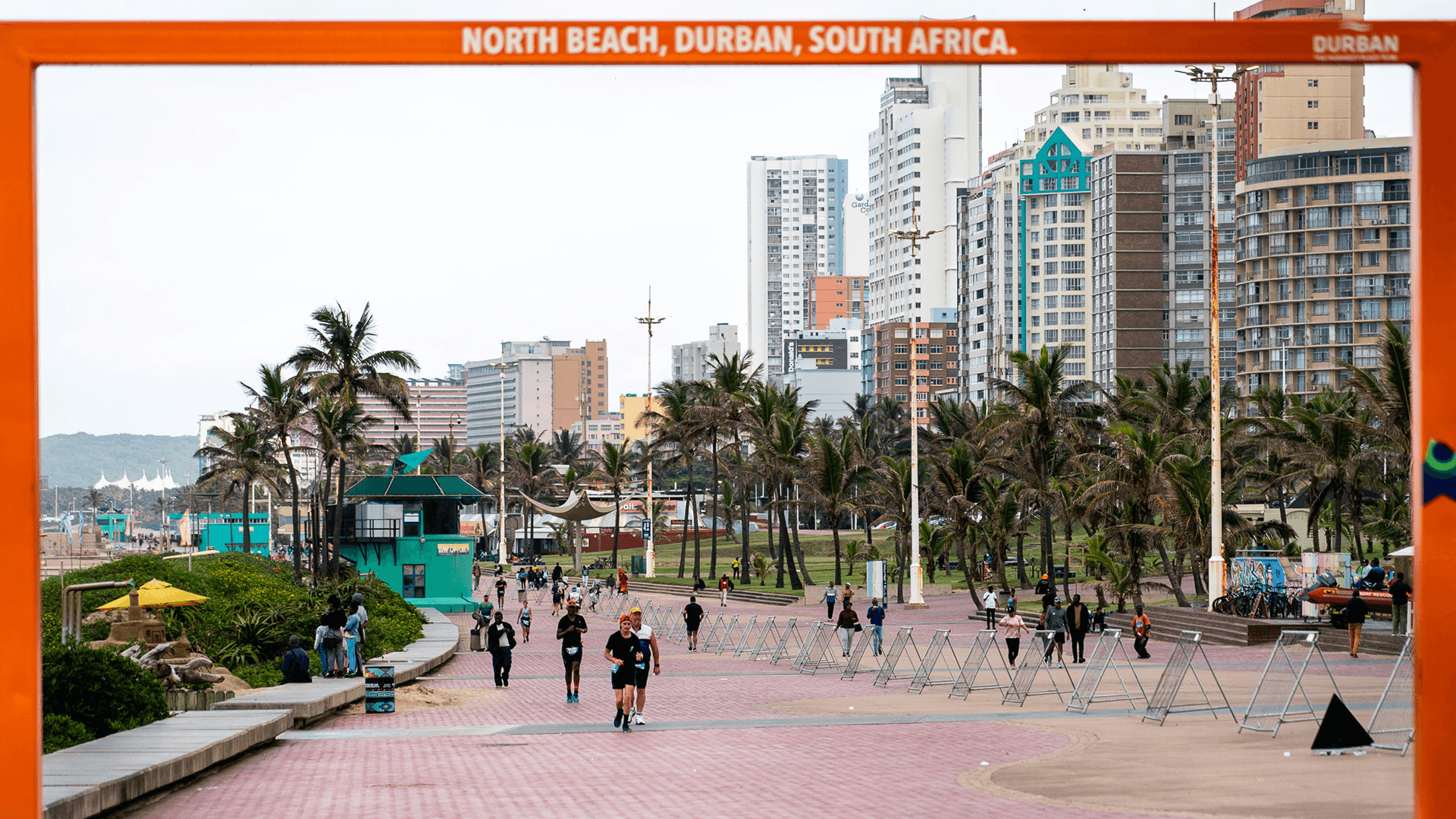
IRONMAN 70.3 DurbanTraining Plan & Race Guide 2026

Durban, South AfricaJune 7, 202670.3 mi — Half Distance7 min read

Race & Course Analysis

As a staple of the African triathlon circuit, IRONMAN 70.3 Durban offers one of the most vibrant and visually striking courses in the Southern Hemisphere. Set against the backdrop of KwaZulu-Natal’s "Golden Mile," the race is a high-speed journey through a subtropical paradise, consisting of a 1.9km ocean swim, a 90km rolling bike leg, and a 21.1km flat-as-a-pancake run. While often touted as a "PB course" due to the flat run and fast highway surface on the bike, the race presents unique technical challenges—specifically the Indian Ocean surf and the deceptive "lumpy" rollers of the M4 highway.

This race is ideally suited for athletes who thrive in humid conditions and those who can maintain a high-power output over undulating terrain. For those seeking an IRONMAN 70.3 Durban training plan, the primary objective is balancing the raw speed required for the run with the specific muscular endurance needed to conquer the bike’s 722 meters of elevation gain without overcooking the legs.

Swim Course

The 1.9km swim is a single-loop rectangular course starting at uShaka Beach. Athletes follow an anti-clockwise direction in the Indian Ocean, where water temperatures typically hover around 22.5°C (72.5°F). While the water is often warm enough to make wetsuits optional for age groupers, the real challenge lies in the surf entry and exit. The "rolling start" format helps thin out the field, but athletes must still navigate "dumping" waves and potentially strong lateral currents that pull parallel to the shore.

  • Distance: 1.9km (1.2 miles)
  • Water Type: Saltwater (Ocean)
  • Course Layout: Single-loop rectangle
  • Key Challenge: Navigating the surf zone and sighting against the urban skyline.

Training Implication: Your preparation must go beyond the pool. Open water swimming (OWS) sessions are non-negotiable, specifically focusing on "dolphin diving" and timing surf entries. You must practice sighting high-contrast landmarks to counter the Indian Ocean currents that can drift you off course.

Bike Course

The 90km bike leg is a two-lap, out-and-back route on the M4 Ruth First Highway. This is a closed-road course featuring a smooth asphalt surface, making it one of the faster bike legs in the 70.3 series. However, the term "flat" is a misnomer; the course is "undulating" or "lumpy," with the majority of the race's 762m total elevation (722m specifically on the bike) coming from short, frequent rollers with gradients between 4% and 6%. The course is also highly exposed to the prevailing North Easterly and South Westerly winds, which can turn the return leg into a grueling headwind battle.

  • Distance: 90km (56 miles)
  • Elevation Gain: 722m
  • Terrain: Undulating highway rollers
  • Road Quality: Excellent, fast-rolling asphalt

Training Implication: To excel here, your IRONMAN 70.3 Durban course profile preparation should prioritize muscular endurance. Incorporate "big gear" intervals (50-60 RPM) on rolling terrain to simulate punching over the M4’s short climbs without spiking your heart rate. Training should also include sustained intervals in the aero position to prepare for the wind-exposed highway segments.

Run Course

The 21.1km run is a two-loop, out-and-back course along the Durban Beachfront Promenade. This is where the race rewards the disciplined cyclist. The terrain is completely paved and exceptionally flat, with a total elevation gain of only 40m. While the lack of vertical gain suggests a fast time, the course is entirely exposed to the sun. With average air temperatures reaching 20°C–23°C (68°F–73°F) and high humidity, the "Golden Mile" can become a heat trap.

  • Distance: 21.1km (13.1 miles)
  • Elevation Gain: 40m
  • Terrain: Paved promenade
  • Sun Exposure: High; very little shade available

Training Implication: Because the run is so flat, it requires a consistent, high-cadence stride. Your training should focus on "brick" sessions that transition from the high-torque demand of the bike rollers to a rhythmic, efficient run pace. Given the subtropical climate, heat acclimation and practicing your high-intensity effort in sun-exposed conditions will be critical to prevent a late-race fade on the promenade.

Training Phase Timeline

16 weeks

Aerobic Foundation

Wk 14 · 4 wk

Strength & Rolling Hills

Wk 58 · 4 wk

Specific Build & Wind Resistance

Wk 912 · 4 wk

Peak Intensity

Wk 1314 · 2 wk

Sharpen & Taper

Wk 1516 · 2 wk

Plan Overview

You will start by building a robust aerobic engine to handle the subtropical humidity of KwaZulu-Natal. As you progress into the second phase, you will focus heavily on the bike course's unique 'lumpy' profile. Since the bike leg accounts for 722m of the race's 762m total elevation gain, you will spend weeks 5 through 8 building the specific leg strength needed to punch over these rollers. This ensures that when you hit the M4 highway, you can maintain a steady rhythm despite the 4% to 6% gradients and the potential for strong South Westerly headwinds. You will also begin practicing sighting in open water to prepare for the Indian Ocean currents and the rectangular swim course at uShaka Beach.

In the final phases, you will transition your focus to the exceptionally flat, 21.1km run along the 'Golden Mile'. While the 40m of gain makes it a fast course, the lack of shade and the 23°C winter sun can be deceptive. You will perform brick sessions that teach you to transition from the rolling bike hills to a high-cadence, efficient run stride on flat pavement. Your training will culminate in a taper that prioritizes recovery, ensuring your legs are fresh for the fast promenade and your mind is sharp for the technical surf exit. By the time you reach transition, you will have the muscular endurance to conquer the rollers and the speed to fly across the Durban beachfront.

Phase 1

Aerobic Foundation

Wk 144 weeks

Building a wide aerobic base and establishing a consistent routine for the swim, bike, and run.

Phase 2

Strength & Rolling Hills

Wk 584 weeks

Developing muscular endurance specifically for the 'lumpy' rollers on the M4 highway bike course.

Phase 3

Specific Build & Wind Resistance

Wk 9124 weeks

Increasing intensity and practicing sustained efforts against simulated wind resistance for the out-and-back bike leg.

Phase 4

Peak Intensity

Wk 13142 weeks

Maximizing race-specific fitness with brick sessions and high-cadence work for the flat promenade run.

Phase 5

Sharpen & Taper

Wk 15162 weeks

Reducing volume while maintaining intensity to arrive fresh and ready for the technical ocean swim.

Race Day Execution

Successfully navigating IRONMAN 70.3 Durban requires more than just fitness; it demands a tactical approach to the subtropical climate, technical surf, and a deceptively demanding bike leg. This guide outlines the FE26-approved execution strategy to help you maximize your performance on the "Golden Mile."

Weather & Climate Strategy

Durban’s winter is mild, but the subtropical humidity and sun exposure are significant factors.

  • Acclimatization: If you are traveling from a colder climate, incorporate 7–10 days of heat prep. Use indoor trainer sessions with reduced airflow or sauna protocols to trigger plasma volume expansion.
  • Sun Management: The run course is entirely exposed. Apply high-quality, water-resistant sunscreen during T2. Even if it feels "cool" at 20°C (68°F), the African sun intensity can lead to rapid core temperature spikes.
  • Wind Awareness: Monitor the prevailing winds. A South Westerly (SW) often brings cooler air but creates a significant headwind on the return legs of the bike. Adjust your power targets by 5-10% to stay aerodynamic rather than fighting the gust.

Nutrition & Hydration Plan

The combination of humidity and the "lumpy" bike course necessitates a proactive fueling strategy.

  1. Carbohydrate Targets: Aim for 60–90g of carbohydrates per hour on the bike. Use the rolling terrain to your advantage—fuel on the descents and flats, and avoid heavy intake during the 4-6% uphill "punches" to prevent GI distress.
  2. Sodium & Electrolytes: Due to high sweat rates in the humidity, target 700–1,000mg of sodium per hour. Use high-concentration electrolyte tabs in your aero-bottle.
  3. Pre-Race Fueling: Consume a high-carb, low-fiber meal 3 hours before the swim start (e.g., oats or white bread with honey). Sip on 500ml of an electrolyte mix in the two hours leading up to the cannon.
  4. The "Pre-Hydration" Rule: You must over-hydrate on the bike. The lack of shade on the run makes it difficult to "catch up" on fluids once you are on the promenade.

Gear & Transition Setup

The split transition (T1 and T2 are 2km apart) requires meticulous organization during the IRONMAN 70.3 Durban preparation tips phase.

  • Bike Gearing: A standard mid-compact (52/36) with an 11-28 or 11-30 cassette is ideal. This allows you to maintain momentum over the M4 rollers without grinding at low cadences.
  • Swim Optics: Use mirrored or tinted goggles. Sighting the buoys against the rising sun over the Indian Ocean can be difficult without them.
  • T1/T2 Logistics: You will rack your bike and bags the day before. Use a checklist to ensure your run shoes and nutrition are at T2 (Suncoast) and your bike gear is at T1 (uShaka). Double-check your tire pressure on race morning as the morning temperature shift can affect PSI.

Pacing & Mental Strategy

Your IRONMAN 70.3 Durban race day strategy should be defined by patience in the first half and aggression in the second.

  • The Swim: Do not fight the surf. Time your entry to "duck" under waves and wait for a gap in the sets. Once past the break, focus on high-elbow S-pulls to counter the lateral currents.
  • The Bike: Resist the urge to "race" other athletes on the highway. Use your power meter to cap your effort on the short 4-6% rollers. Burning too many "matches" here will result in heavy legs on the flat run.
  • The Run: Start at a cadence of 90+ RPM. The transition from the "lumpy" bike to the dead-flat run can feel strange; focus on a short, quick stride.
  • Mental Reset: Use the turnaround points on the M4 highway and the promenade to reset your focus. If the wind picks up, tuck into your aero bars and focus on a "rhythm over power" mantra.

Travel & Logistics

Efficiency in the days leading up to the race preserves vital glycogen stores.

  • Arrival: Aim to arrive by Thursday evening. This gives you Friday for registration and a brief course recon, and Saturday for the split-transition bag drop.
  • Accommodation: Stay at the Suncoast Towers or hotels along the North Beach promenade. Being within walking distance of the finish line and T2 simplifies your race-morning logistics significantly.
  • Course Recon: Drive the M4 highway out-and-back to visualize the "lumpy" sections. On Friday morning, perform a 15-minute "dip" at uShaka Beach to practice timing the surf entry; the Indian Ocean "dump" is unique and requires a specific feel for the water.

Your Personalized Training Plan

Your Personal Path to IRONMAN 70.3 Durban

While this guide provides a foundation, every athlete is unique. FE26 creates a personalized plan by analyzing:

  • Your Data: Seamless Strava integration to benchmark your current fitness.
  • Your Life: Training blocks that adapt to your real-world schedule.
  • The Course: Workouts specifically engineered for these unique race demands.
  • Your Recovery: Weekly adaptive periodization that adjusts targets based on your actual performance.

Stop guessing your intervals. Start training with a system that evolves with you.

Create Your IRONMAN 70.3 Durban Training Plan