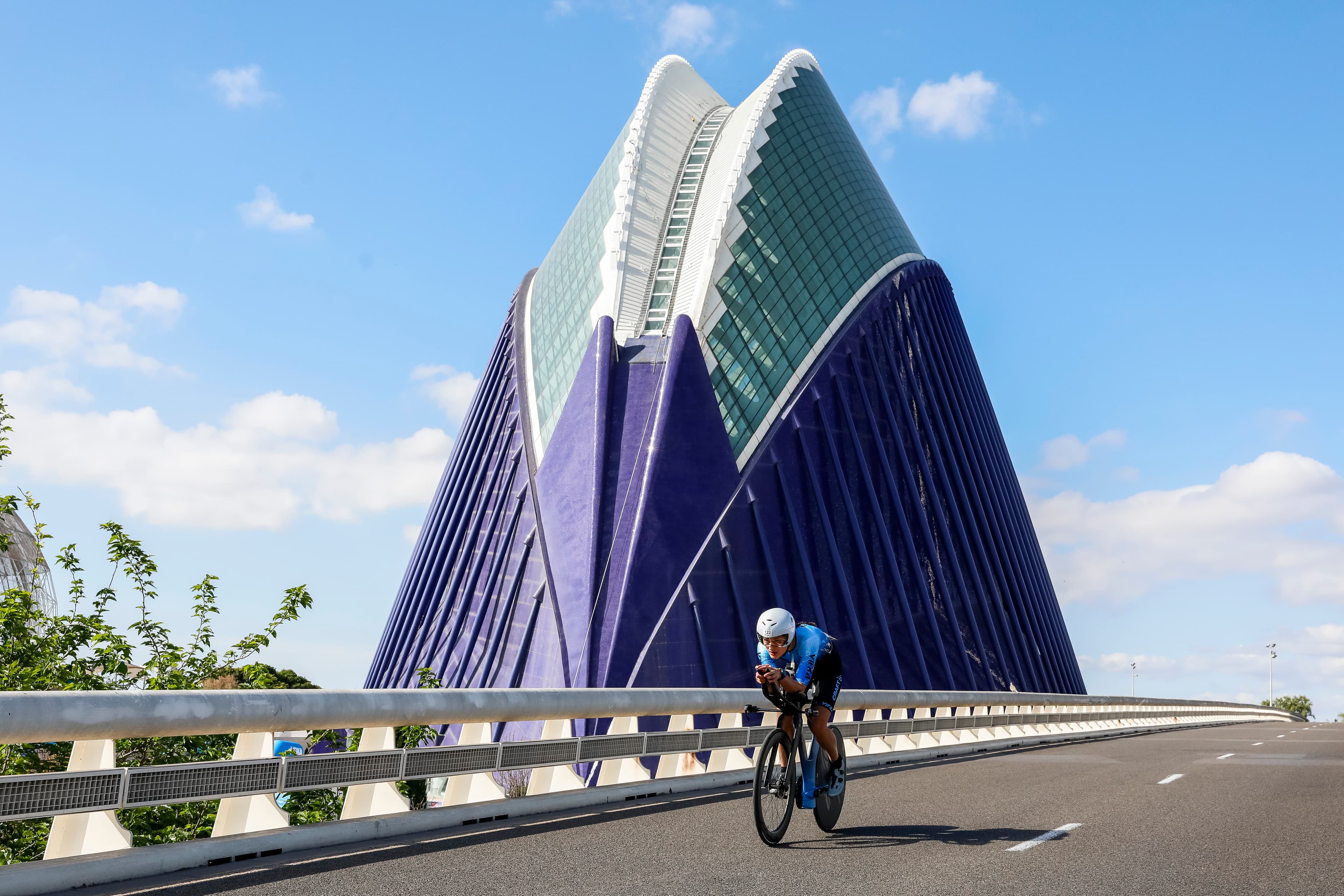
IRONMAN 70.3 ValenciaTraining Plan & Race Guide 2026
Valencia, SpainApril 19, 202670.3 mi — Half Distance2 min readPublished April 1, 2026Updated July 4, 2026
Share
01·Course Characteristics
The measure of Valencia
A fast, flat run and sheltered harbor swim contrast with a rolling, wind-exposed bike leg through the mountains. Managing early-season heat and split-transition logistics defines this Mediterranean race.
Climate
23°C
Peak air · water 16-18°C · mid-April
Conditions
Windy
Coastal crosswinds · sheltered harbor · unshaded run
Elevation
600-700 m
Rolling mountain terrain · steady grades up to 7.8%
Difficulty
6 / 10
A sheltered swim and flat run make for fast times, but coastal winds and rolling mountain climbs keep the overall demand moderate.
This edition has passed
Training for a future IRONMAN 70.3 Valencia?
Registration for the next edition opens on a rolling basis. Start building your base now and we'll size a full plan the moment a new date is set.
A single counter-clockwise loop within the protected Marina de Valencia surrounding the Veles e Vents building. The water is exceptionally calm and sheltered, making sighting highly straightforward with virtually no current.
02
Bike
Sierra de la Calderona
Point-to-point to City of Arts and Sciences
DISTANCE
90 km
LOOPS
1
ELEVATION
600-700 m
TERRAIN
Rolling
SURFACE
Smooth asphalt
WIND
Crosswinds
A fast single loop starting from T1 at the Marina, heading north before climbing inland toward the mountains. The route features gradual 1% to 4% climbs with short pitches up to 7.8% before a rapid descent back to the city.
03
Run
Turia Gardens
Jardín del Turia
DISTANCE
21.1 km
LOOPS
2
ELEVATION
5-50 m
SURFACE
Paved park paths
SHADE
Partial
PEAK TEMP
23°C
An exceptionally flat, two-lap urban park course running through the diverted riverbed of the Turia Gardens. Paved paths lined with trees offer occasional shade, though open sections are exposed to direct midday sun before the finish at the iconic City of Arts and Sciences.
03·AVG beginners' Training Timeline
From zero to the finish line
16 weeks
This 16-week layout progresses from a solid aerobic foundation to specific strength work for the rolling mountain bike segment. It culminates in sustained aero-position intervals and heat-tolerance prep to tackle Valencia's flat, unshaded run.
Today · WK 0Race Day
WK 1–4
Aerobic Foundation
Establish your aerobic base with low-intensity volume across all three disciplines.
WK 5–8
Strength & Rolling Power
Introduce low-cadence climbing intervals on the bike to build strength for Sierra de la Calderona.
WK 9–13
Race-Specific Build
Target high-sustained efforts in the aero position and flat run-off-the-bike pacing sessions.
WK 14–16
Taper & Sharpen
Reduce volume while maintaining brief high-intensity efforts to ensure you arrive fresh and fast.
Adapts to your fitness, schedule & recovery every week.
Expect cool morning air around 11°C warming to 23°C by midday. Use the run aid stations every 1.5 to 2 km to douse your head and body with water and sponges to combat the direct midday sun.
Fuel & hydration
Target 60-90g of carbohydrates per hour on the high-speed bike using the four aid stations. On the flat, fast run, drink at every station to maintain hydration in the dry, warm afternoon air.
Pacing
Keep your effort controlled on the steady Sierra de la Calderona climbs to save your legs. Maintain a stable aero position on the fast descents and flat coastal roads to maximize speed against the headwind.
Gear & logistics
With a split transition, rack your bike and blue bike bag at T1 on Saturday, and drop your red run bag at T2. Use a moderate wheel depth to stay stable in the unpredictable coastal crosswinds.
Frequently Asked Questions
What is the water temperature and wetsuit policy for the IRONMAN 70.3 Valencia swim?
The water temperature in the Marina de Valencia typically averages between 16°C and 18°C (61°F to 64°F) in mid-April. Because of these cool temperatures, wetsuits are highly recommended and are typically mandatory for age-group athletes. The swim itself is highly protected and calm, with virtually no currents or swell to worry about.
How hard is the IRONMAN 70.3 Valencia bike course?
The bike course has a moderate difficulty rating of 6/10, featuring a single loop with approximately 600m to 700m (1,968–2,296 ft) of total elevation gain. You will face rolling terrain and gradual climbs of 1% to 4% grade as you head inland toward the Sierra de la Calderona mountains, with only short sections hitting up to 7.8%. The road surface consists of exceptionally smooth Spanish asphalt, but you should prepare for potential crosswinds when using deep-section wheels.
What is the run course like for IRONMAN 70.3 Valencia?
The run is an exceptionally flat, lightning-fast 2-lap urban park course through the Turia Gardens, featuring minimal elevation gain of just 5m to 50m. The terrain is 100% paved paths lined with trees, historic bridges, and passionate crowds. While there is periodic shade, some sections are fully exposed to the midday sun, where air temperatures can reach 23°C (73°F).
How does the split transition work at IRONMAN 70.3 Valencia?
This race features a split transition layout, meaning Transition 1 (T1) is located at the Marina de Valencia and Transition 2 (T2) is at the City of Arts and Sciences. On Saturday, you must rack your bike and deposit your blue bike bag at T1, while your red run bag must be dropped off at T2. Booking your lodging near T2 is highly recommended so you can easily walk back to your room after finishing.
What are the cutoff times for IRONMAN 70.3 Valencia?
The event enforces strict cutoff times to ensure athlete safety across the course. You must complete the 1.9 km swim within 1 hour and 10 minutes, and the combined swim and bike portions within 5 hours and 30 minutes. The absolute time limit to cross the finish line and complete the entire race is 8 hours and 30 minutes.
Your Personalized Plan
Stop guessing your intervals. Train for this course.
FE26 builds your plan around your Strava data, your real schedule, and the exact demands of IRONMAN 70.3 Valencia— then adapts every week to how you actually perform.