A rectangular swim entirely contained within the harbor basin, starting and ending near the Culture Yard. The harbor walls offer shelter from open-sea swells, but expect tight turns around the buoys.
02
Bike
The North Zealand Loop
North Zealand Coast and Countryside
DISTANCE
90 km
LOOPS
1 loop
ELEVATION
550 m
TERRAIN
Rolling
WIND
Moderate coastal
A single-loop route heading north along the coast before turning inland through rolling hills and forests. The roads are fast and well-paved, but exposed coastal stretches invite persistent headwinds.
03
Run
The Kronborg Castle Loops
Kronborg Castle and Harbor
DISTANCE
21.1 km
LOOPS
3.5 loops
ELEVATION
50 m
SURFACE
Asphalt & cobblestones
SHADE
Minimal
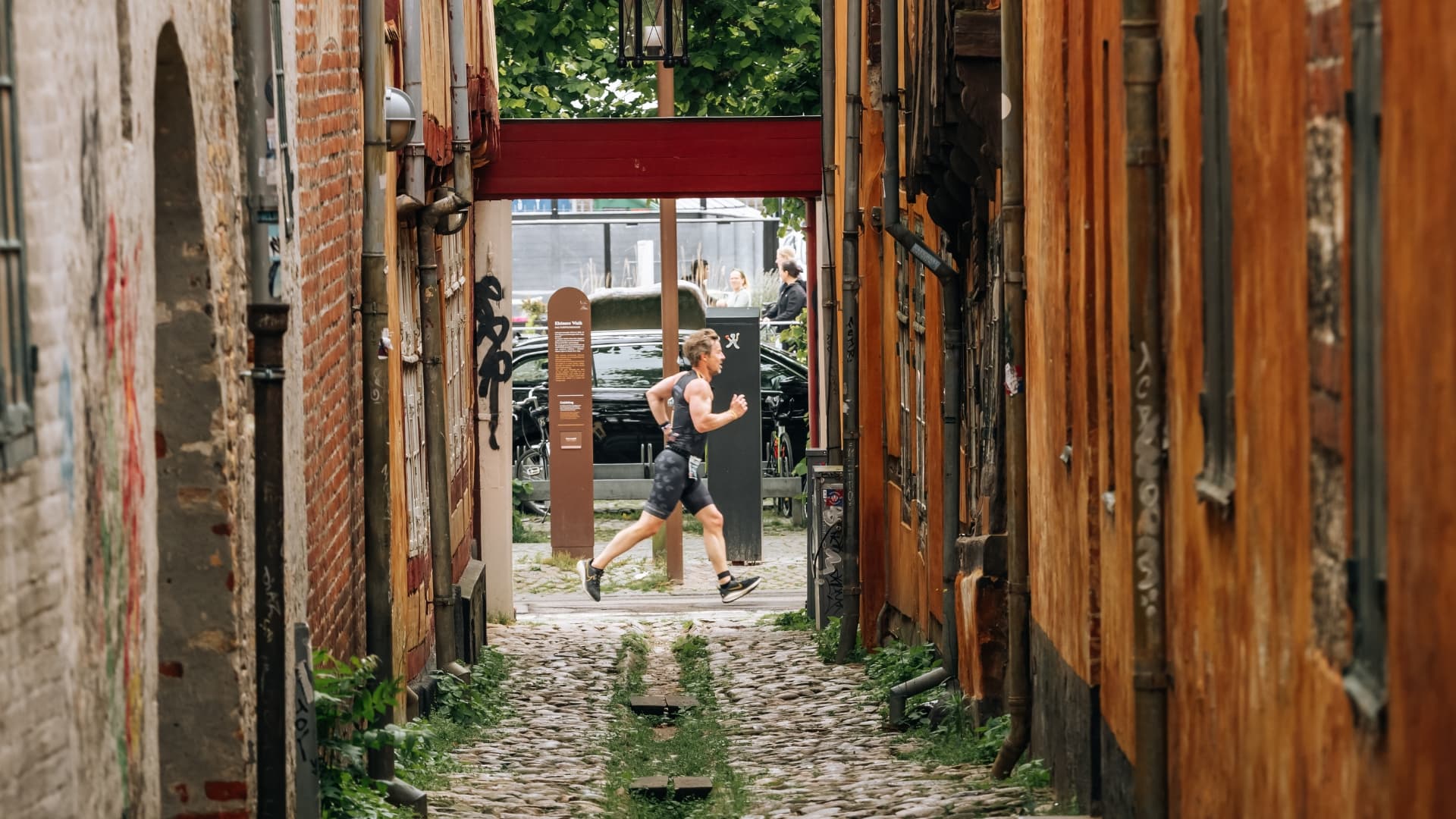
A multi-loop run taking you directly through the historic gates of Kronborg Castle and along the harbor. The course is incredibly flat and packed with spectators, though the cobblestone sections require focused footwork.
03·AVG beginners' Training Timeline
From zero to the finish line
16 weeks
This 16-week progression systematically prepares you for Elsinore's specific challenges. We build your aerobic engine first, transition to building heavy wind-resistance power in the aero bars, and finish with run brick sessions on mixed surfaces so you can handle the transition to the cobblestones.
Today · WK 0Race Day
WK 1–4
Aerobic Foundation
Build baseline endurance and get comfortable with cool open-water swimming.
WK 5–8
Strength & Aero Development
Develop sustained power in the aero position to combat the Danish coastal winds.
WK 9–13
Race-Specific Build
Simulate race-pace efforts with brick runs, introducing undulating bike sets and cobblestone run segments.
WK 14–16
Taper & Execution
Reduce training volume to shed fatigue while maintaining high-intensity efforts to stay sharp.
Adapts to your fitness, schedule & recovery every week.
Prepare for cool morning air around 13°C rising to a mild 20°C. While overheating is rare, high humidity and direct sun on the exposed run mean you should still take water at every aid station to keep core temperatures stable.
Fuel & hydration
Target 80-90g of carbohydrates and 600-800ml of fluid per hour on the bike. The cool Baltic breeze can mask sweat loss, so drink on a strict timer rather than relying on thirst alone.
Pacing
Hold a disciplined effort on the outbound coastal bike leg where headwinds are strongest. Save your legs for the run, where the flat profile invites a fast pace but the frequent corners and cobblestones will break your rhythm.
Gear & logistics
Opt for a mid-depth front wheel (50-60mm) and a disc rear, as coastal winds can gust. Pack a neoprene swim cap for the chilly harbor water, and choose running shoes with reliable grip for the damp cobblestones.
Frequently Asked Questions
What is the swim like at IRONMAN 70.3 Elsinore?
The swim takes place in the harbor basin near the historic Kronborg Castle, offering highly sheltered water with minimal swell. You can expect water temperatures to hover around 15°C to 18°C (59°F to 64°F), making a wetsuit highly recommended and usually mandatory. The one-lap, rectangular course is easy to navigate, though the salt water provides excellent natural buoyancy to help your body position.
How flat is the IRONMAN 70.3 Elsinore bike course?
The bike course is exceptionally fast and flat, featuring rolling terrain through the Danish countryside with only about 350 meters (1,150 feet) of total elevation gain over the 90km loop. While the profile is ideal for staying in your aerobars, you must prepare for open coastal sections where strong Baltic winds can increase the aerodynamic resistance. Smooth asphalt roads allow for excellent rolling speed, but cautious cornering is required through the technical turns near the transition area.
What should I expect on the IRONMAN 70.3 Elsinore run course?
The run is a flat, three-and-a-half-lap course that winds directly around the majestic Kronborg Castle and the harbor area. It features a mix of paved roads, hard-packed gravel, and a short cobblestone section near the castle fortress that requires careful footing. The compact, spectator-friendly layout means you will be boosted by incredible crowd support along the entire 21.1km route.
What is the typical weather for IRONMAN 70.3 Elsinore in June?
Late June in Denmark typically brings pleasant, mild summer racing conditions with average air temperatures ranging from 14°C to 20°C (57°F to 68°F). While mornings can feel crisp, daytime temperatures are highly comfortable for running, though you should prepare for the possibility of overcast skies and passing coastal showers. Winds off the sea are common, so managing your pacing and aerodynamics on the bike is key to a strong run.
Is IRONMAN 70.3 Elsinore a good race for beginners?
Yes, Elsinore is one of the most beginner-friendly races on the European circuit due to its sheltered harbor swim, very low total bike elevation, and flat run course. The logistics are incredibly straightforward, with the transition area, swim start, and finish line all centrally located near the Culture Yard. The high-energy, multi-lap run course ensures you are never far from support, making it an ideal venue to target your first middle-distance finish.
Your Personalized Plan
Stop guessing your intervals. Train for this course.
FE26 builds your plan around your Strava data, your real schedule, and the exact demands of IRONMAN 70.3 Elsinore— then adapts every week to how you actually perform.