All Race Guides

IRONMAN 70.3 FloridaTraining Plan & Race Guide 2026

Haines City, United StatesDecember 13, 202670.3 mi — Half Distance7 min read

Race & Course Analysis

Ultimate IRONMAN 70.3 Florida Course Profile and Training Strategy

For triathletes looking to close out their season with a late-year challenge, IRONMAN 70.3 Florida in Haines City offers a unique and surprisingly demanding test. On December 13, 2026, athletes will take on a 70.3-mile journey comprising a 1.2-mile swim, 56-mile bike, and 13.1-mile run. While Florida is legendary for its pancake-flat coastline, this central inland course in Polk County shatters that reputation, serving up rolling hills, technical navigation, and exposed terrain that will reward those who show up with a specific, science-backed preparation strategy.

This race is ideal for athletes searching for a late-season speed test but demands a robust physical foundation. With its centralized hub at Lake Eva Park, the course delivers incredible spectator energy alongside a surprisingly muscular profile. To excel here, your IRONMAN 70.3 Florida training plan must look beyond flat-land speed and actively prepare you for undulating terrain, open-road winds, and relentless humidity.

Swim Course

The 1.2-mile (1.9 km) freshwater swim takes place in the generally calm waters of Lake Eva, featuring a self-seeded rolling start from a white sand beach. With average water temperatures ranging from 67°F to 73°F (19°C to 23°C), the swim is typically wetsuit-legal. However, the true defining feature of this swim is its famous "M-Dot" layout—a highly technical, multi-turn course requiring athletes to navigate up to six distinct turns.

  • Key Challenges: The frequent directional changes often create physical bottlenecks and navigation confusion. Without highly developed open-water tracking, athletes regularly swim 100 to 200 yards long.
  • Training Implication: Your swim training must prioritize frequent sighting and bilateral breathing. Incorporate sighting drills every 4 to 6 strokes during pool-based endurance sets. This ensures you can maintain a straight line and preserve energy despite the constant twists of the Lake Eva layout.

Bike Course

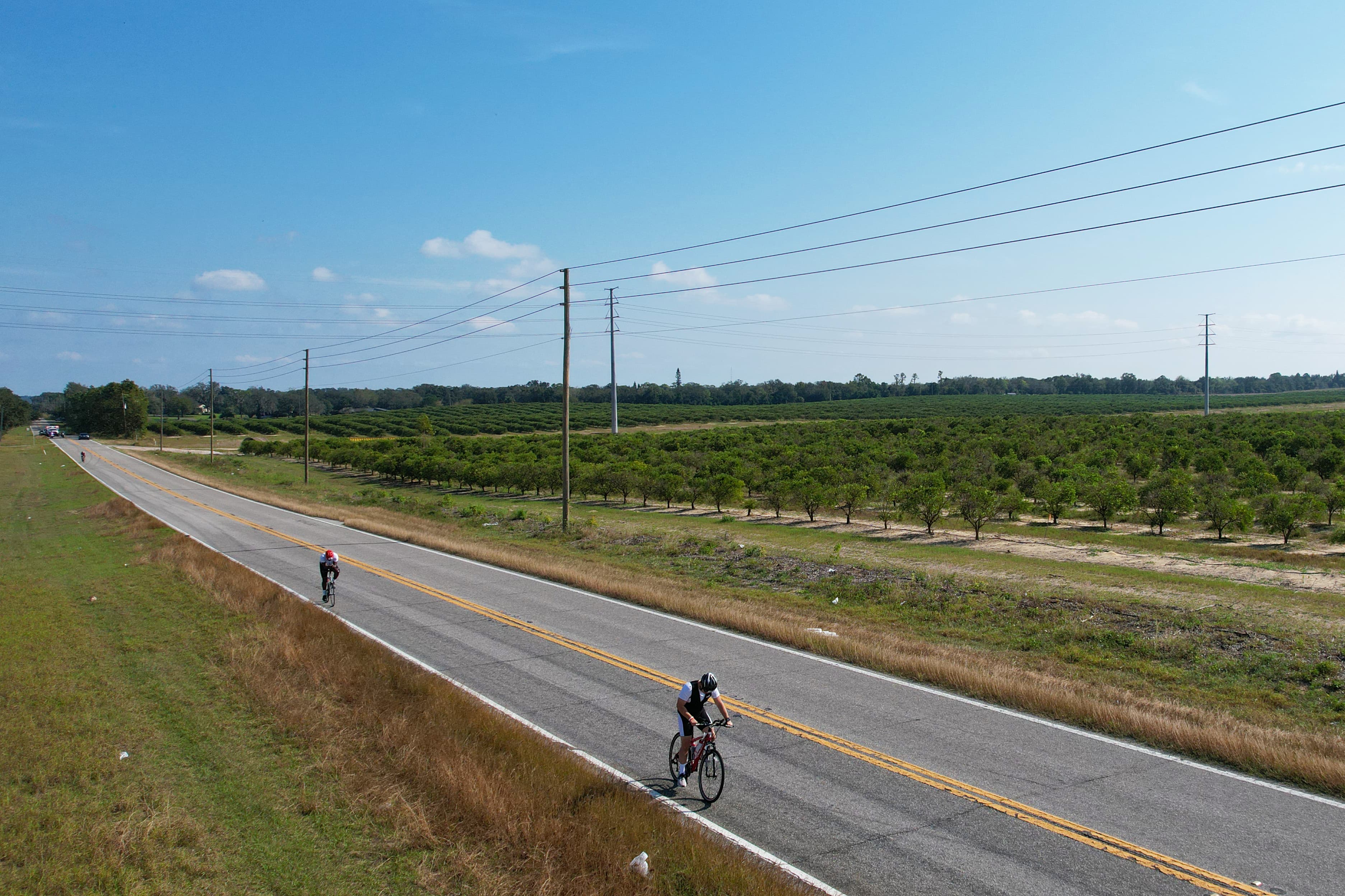
The 56-mile (90 km) single-loop bike course winds through eastern Polk County's scenic orange groves and rural roads. Do not let the "Florida" label fool you; this course features roughly 1,200 to 1,369 feet (365m to 417m) of total elevation gain. While the first 20 to 28 miles are relatively flat and fast, the rolling hills begin in earnest after mile 28, forcing you to climb on increasingly tired legs.

  • Key Challenges: Much of the course travels along open, highly exposed rural roads, making riders vulnerable to strong crosswinds averaging 10 to 11 mph. Additionally, athletes must handle a notable "washboard" rough road surface around mile 40 and remain alert on sections shared with bypass traffic.
  • Training Implication: To prepare for this IRONMAN 70.3 Florida course profile, focus your training on aerodynamic stability and strength endurance. Incorporate low-cadence hill intervals (50 to 60 RPM) on your long rides to build the muscular torque needed for the late-stage rollers. Practice holding a rock-solid aero position on your trainer to build the core resilience required to combat the crosswinds.

Run Course

The concluding 13.1-mile (21.1 km) run is a two-loop course around Lake Eva, on paved trails and roads. Far from flat, the run packs a surprising punch with 540 to 558 feet (164m to 170m) of total elevation gain. The course features very little shade, exposing athletes directly to the intense Central Florida sun and high humidity.

  • Key Challenges: Each of the two loops begins with a steep, immediate climb right out of transition. Often referred to by alumni as "the death march," this recurring incline spikes your heart rate before you can establish a rhythm.
  • Training Implication: Your training must focus on building hill resilience on tired legs. Program strength-based hill loops and "over-under" run intervals. Most importantly, practice specific transition brick sessions where you begin your run with an immediate, steep uphill effort. Training your body to handle this initial metabolic shock will allow you to settle into your target half-marathon pace without blowing up.

Training Phase Timeline

16 weeks

Aerobic Base & Strength

Wk 14 · 4 wk

Strength Endurance & Sighting

Wk 58 · 4 wk

Specific Muscular Endurance

Wk 912 · 4 wk

Peak & Course Simulation

Wk 1314 · 2 wk

Taper & Neuromuscular Sharpness

Wk 1516 · 2 wk

Plan Overview

Welcome to your training plan for IRONMAN 70.3 Florida! To conquer the surprisingly rolling profile of Haines City, you will need a training program that respects both the undulating terrain and the humid Central Florida climate. We have structured this 16-week plan to systematically prepare you for the race's specific demands, moving from a foundational base of pure aerobic capacity to highly targeted race-simulation work. While Florida has a reputation for being flat, this course features over 1,200 feet of rolling elevation on the bike and another 540-plus feet of steep climbs on the run. You will start by building a robust aerobic engine and crucial core stability to handle the crosswinds and rougher road surfaces you will meet around mile 40 of the bike course. As you progress into the strength endurance and specific phases, the training shifts to replicate the unique flow of the Haines City course. Because the first half of the bike is flat and fast, but the back half introduces rolling hills, you will practice workouts that demand high power outputs on tired legs. Furthermore, to prepare for the technical M-Dot swim with its six turns, you will integrate heavy sighting and bilateral breathing drills. Your brick sessions will specifically prepare your legs for the infamous steep climbs right out of transition. By simulating these transitions, you will train your body to manage the immediate spike in heart rate before settling into your target half-marathon pace. In the final peak and taper weeks, you will focus on heat adaptation and fine-tuning your nutrition. With temperatures reaching the high 70s coupled with high humidity, managing your hydration is just as important as your physical fitness. You will practice taking in high amounts of sodium and carbs on your long brick days to ensure your gut is fully trained. By the time you taper down to shed fatigue in the final two weeks, you will feel completely confident in your pacing strategy, your ability to handle the late-stage hills, and your plan to stay cool and fast in the Florida sun.

Phase 1

Aerobic Base & Strength

Wk 144 weeks

Develop a strong cardiovascular foundation and full-body stability to prepare your body for the physical demands of Haines City's rollers and open-road crosswinds.

Phase 2

Strength Endurance & Sighting

Wk 584 weeks

Build specific muscular endurance with low-cadence bike intervals and focus on open-water swim sighting to master Lake Eva's unique 6-turn M-Dot course.

Phase 3

Specific Muscular Endurance

Wk 9124 weeks

Replicate the late-stage rolling hills of the bike course and incorporate brick runs that prepare your legs for the immediate climbs out of transition.

Phase 4

Peak & Course Simulation

Wk 13142 weeks

Execute race-pace simulations in simulated warm and humid conditions, focusing on executing your nutrition strategy under high physical stress.

Phase 5

Taper & Neuromuscular Sharpness

Wk 15162 weeks

Reduce training volume to shed accumulated fatigue while keeping intensity high enough to stay sharp, fresh, and ready to tackle the Florida sun.

Race Day Execution

Executing a successful race in Haines City requires a smart balance of thermal management, disciplined pacing over deceptive rolling terrain, and sharp mental focus. Use these science-backed IRONMAN 70.3 Florida preparation tips and our definitive IRONMAN 70.3 Florida race day strategy to master this unique, centralized venue.

Weather & Climate Strategy

The high humidity and warm afternoon temperatures of Central Florida demand a proactive thermal management strategy.

  • Pre-Race Heat Acclimation: If training in a cooler climate, integrate active heat protocols 2 to 3 weeks before race day. Execute 3 to 4 weekly sessions of 30 minutes in a hot bath or sauna immediately following your standard training rides or runs.
  • Pre-Cooling Protocol: On race morning, sip ice-cold fluids up until you line up for the swim.
  • On-Course Cooling: Do not wait until you feel hot to start cooling your body. From the very first aid station on the run, grab ice and place it inside your tri-suit against your chest, back, or under your cap. This lowers skin temperature and reduces cardiovascular strain, allowing you to maintain target pacing.

Nutrition & Hydration Plan

High humidity limits sweat evaporation, accelerating fluid and electrolyte loss. Your nutrition plan must be executed with precision.

  • Pre-Race Fueling Timeline: Consume 2 to 3 grams of simple carbohydrates per kilogram of body weight 2.5 to 3 hours before the swim start. Supplement this with 500–700 ml of water mixed with 1,000 mg of sodium to optimize blood plasma volume.
  • Bike Hydration & Carb Targets: Aim for 80 to 100 grams of carbohydrates per hour, primarily through a concentrated liquid or gel setup. Target a fluid intake of 750 to 1,000 ml per hour, containing 700 to 1,000 mg of sodium per liter to combat the humid conditions.
  • Run Fueling: Shift your intake to easily digestible gels and sports drinks, targeting 60 to 80 grams of carbohydrates per hour. Consume water at every single aid station to match your sweat rate.

Gear & Transition Setup

Your equipment choices should optimize both aerodynamics in open-road crosswinds and heat dissipation.

  • Goggle Choice: Opt for polarized or dark-mirrored goggles. Sighting into the early morning Florida sun on the multi-turn swim course can be highly disorienting.
  • T1 Sand Wash: Place a pressurized bottle of fresh water at your transition spot. Use it to quickly rinse sand off your feet before putting on your cycling shoes to prevent friction-induced blisters.
  • T2 Anti-Chafe Protocol: Due to high humidity and sweat accumulation, apply a generous layer of anti-chafe cream to your underarms, groin, and toes during your T2 setup. Use lock-laces on your running shoes to ensure a quick transition before the immediate climb.

Pacing & Mental Strategy

A flawless race morning routine sets up a controlled, calculated effort across all three disciplines.

Race Morning Timeline:
3:00 AM — Wake up, consume pre-race meal, and begin hydration
4:30 AM — Arrive at Lake Eva Park transition (before local road closures lock down)
5:15 AM — Check tire pressure, calibrate power meter, and mount nutrition
6:00 AM — Complete a dynamic dry-land warm-up
6:15 AM — Position yourself in the rolling swim start queue
  • Swim Pacing: Do not rush the start. Focus on high-frequency sighting (every 4 to 6 strokes) to navigate the technical multi-turn layout. Draft behind swimmers with a straight trajectory to save up to 10% of your energy.
  • Bike Pacing: Keep your effort strictly capped during the flat and fast first half of the ride. When you hit the rolling terrain in the second half, shift gears early to maintain a smooth, steady cadence of 85–95 RPM. Avoid spiking your power on the short rollers; keep your Normalized Power close to your Average Power to save your running legs.
  • Run Pacing: Resist the urge to sprint out of transition. The immediate steep climb out of T2 requires a high-cadence, short-stride technique. Keep your heart rate under control here; pushing too hard early will cause you to blow up on the unshaded second loop.
  • Common Mistake to Avoid: Over-biking the flat section. Many athletes burn too many "matches" early on the flat roads, leaving them completely depleted for the late-stage rollers and the hilly run.

Travel & Logistics

  • Arrival & Logistics: Fly into Orlando International Airport (MCO) and rent a car. Plan to arrive by Thursday afternoon to register, attend the athlete briefing, and settle into the venue without rushing.
  • Where to Stay: Secure a vacation rental in nearby Davenport or Kissimmee, or book a host hotel in Haines City. Staying close to Lake Eva Park ensures simple logistics, as the swim, transitions, and finish line are all centralized.
  • Course Recon: Drive the second half of the bike course on Friday to visualize the transitions into the rolling hills. On Friday or Saturday, jog the first mile of the run course from Lake Eva Park to mentally prepare for the steep incline.

Your Personalized Training Plan

Your Personal Path to IRONMAN 70.3 Florida

While this guide provides a foundation, every athlete is unique. FE26 creates a personalized plan by analyzing:

  • Your Data: Seamless Strava integration to benchmark your current fitness.
  • Your Life: Training blocks that adapt to your real-world schedule.
  • The Course: Workouts specifically engineered for these unique race demands.
  • Your Recovery: Weekly adaptive periodization that adjusts targets based on your actual performance.

Stop guessing your intervals. Start training with a system that evolves with you.

Create Your IRONMAN 70.3 Florida Training Plan