IRONMAN 70.3 Gulf CoastTraining Plan & Race Guide 2026
Panama City Beach, United StatesMay 9, 202670.3 mi — Half Distance2 min readPublished April 2, 2026Updated July 23, 2026
Share
01·Course Characteristics
The measure of Gulf Coast 70.3
A deceptively flat course where relentless pedaling, coastal crosswinds, and thick Florida humidity replace traditional climbing to create a demanding test of mental stamina and heat management.
Climate
31°C
Peak air · water 23-26°C · high humidity
Conditions
Exposed
Severe coastal winds · 90% humidity · minimal shade
Elevation
200 m
Extremely flat · non-technical · minor bridges
Difficulty
5.5 / 10
Though flat and beginner-friendly, the lack of coasting on the bike and the high coastal winds and humidity during the run significantly increase the overall physical toll.
This edition has passed
Training for a future IRONMAN 70.3 Gulf Coast?
Registration for the next edition opens on a rolling basis. Start building your base now and we'll size a full plan the moment a new date is set.
A single-loop, clockwise ocean swim starting in the Gulf of Mexico. Water conditions can vary from glassy and calm to highly choppy with strong currents, waves, and rip tides. Sighting is particularly challenging on the return leg because you swim directly into the rising morning sun.
02
Bike
The Flat Aero Grind
Pine Log State Forest out-and-back
DISTANCE
90 km
LOOPS
1 loop
ELEVATION
200 m
WIND
14-32 km/h
TERRAIN
Extremely flat
SURFACE
Smooth pavement
An extremely flat single-loop course heading inland through intercoastal waterways. Because there are no real climbs or descents, there is no opportunity to coast, demanding constant pedaling in the aero position for the entire ninety kilometers.
03
Run
The Beach Road Loops
Front Beach Road
DISTANCE
21.1 km
LOOPS
3 loops
ELEVATION
20 m
SHADE
Minimal
PEAK TEMP
29-31°C
SURFACE
Paved road
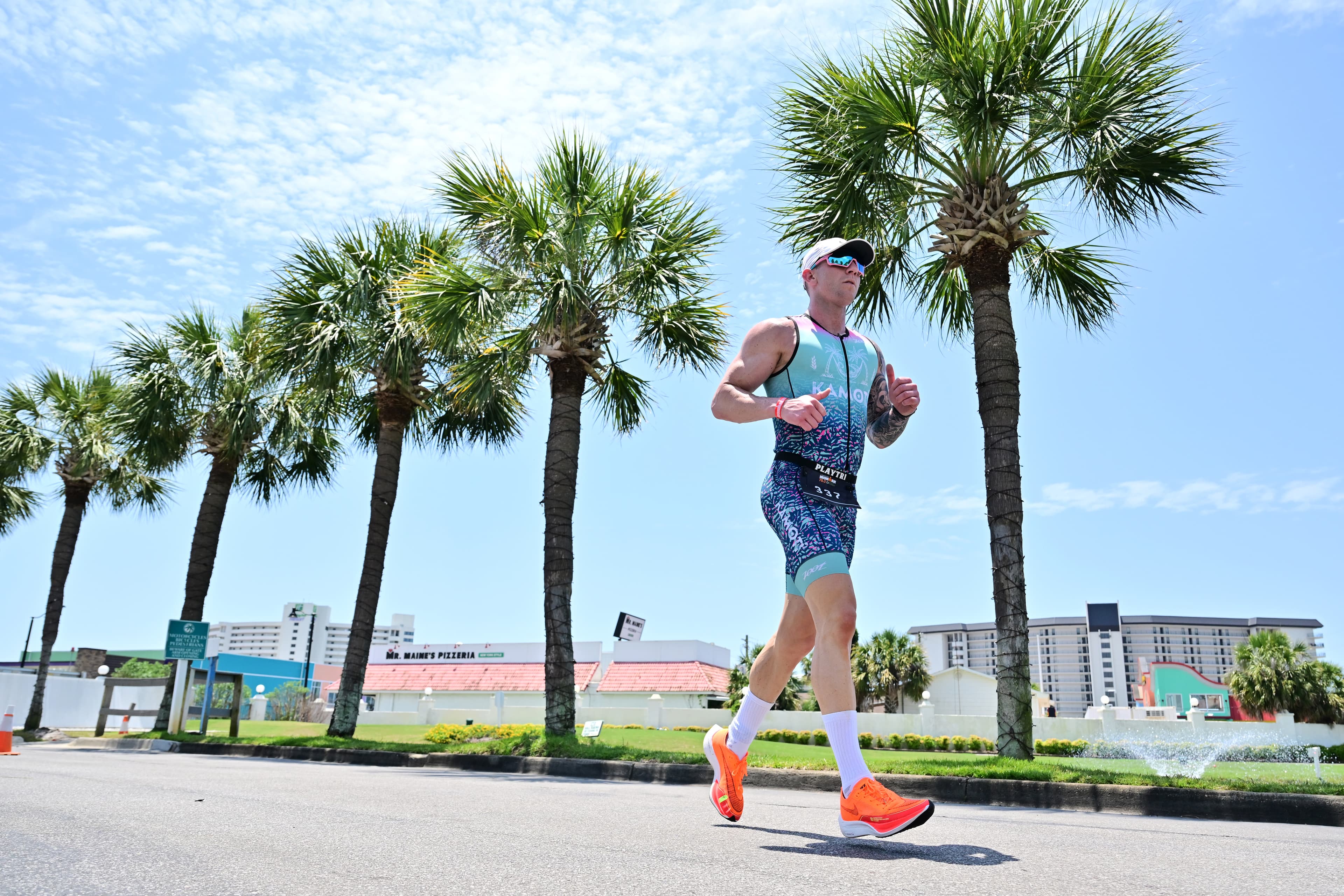
A flat, three-loop road course wrapping along Front Beach Road and surrounding beachside neighborhoods. The route is highly exposed to the sun and rising afternoon temperatures with very little shade to protect you from the heat.
03·AVG beginners' Training Timeline
From zero to the finish line
16 weeks
This 16-week plan transitions you from basic aerobic conditioning to course-specific muscular endurance. Because the Panama City Beach course features zero climbing, you will focus heavily on building the core and hip-flexor stamina needed to pedal continuously in the aero position, followed by targeted heat acclimation to survive the humid run.
Today · WK 0Race Day
WK 1–4
Aerobic Base & Core Strength
Develop joint durability and initial aerobic capacity to handle the upcoming training volume.
WK 5–8
Aero Position Durability
Build the neck, lower back, and hip flexor strength required to sustain a continuous aerodynamic tuck.
WK 9–12
Relentless Muscular Endurance
Train your body to pedal continuously without recovery, simulating the flat nature of the bike course.
WK 13–14
Heat & Wind Specificity
Introduce heat acclimation strategies and simulate race-pace efforts in simulated coastal conditions.
WK 15–16
Taper & Strategy Execution
Reduce training volume to shed fatigue while executing race-pace brick workouts and final hydration planning.
Adapts to your fitness, schedule & recovery every week.
Expect humidity levels up to 90% and afternoon highs of 31°C. At every run aid station, prioritize stuffing ice down your trisuit and pouring cold water over your head to keep your core temperature stable.
Fuel & hydration
With high sweat rates due to the humidity, aim for 60 to 80 grams of carbohydrates and high sodium replacement per hour on the bike. Do not skip the final bike aid stations between kilometers 67 and 72 to ensure you start the run fully hydrated.
Pacing
On the flat bike course, manage your power strictly and avoid over-riding early; saving energy is crucial since you cannot coast. On the run, pace yourself conservatively through the first loop to gauge your heat tolerance before pushing.
Gear & logistics
Bring both a wetsuit and a swimskin since water temperatures hover around the 23-26°C legal limit. Choose a deeper aero front wheel if wind is low, but prepare for gusty 14-32 km/h coastal winds. Book accommodation at Edgewater Resort to easily walk to transition.
Frequently Asked Questions
What is the water temperature and wetsuit policy for the IRONMAN 70.3 Gulf Coast swim?
The water temperature in early May typically ranges between 74°F and 78°F (23°C to 26°C), which sits right on the borderline of wetsuit legality. Because of this, you should pack both a wetsuit and a swimskin to ensure you are prepared for any ruling on race morning. The swim takes place in the open saltwater of the Gulf of Mexico, where conditions can range from dead calm to highly choppy with strong currents.
How hard is the IRONMAN 70.3 Gulf Coast bike course?
The 56-mile bike course is extremely flat and fast with only 617 to 700 feet of total elevation gain, making it 6.2% easier than the global average. However, it is deceptively difficult because the lack of hills means you must pedal constantly in the aero position with no opportunities to coast. You will also need to prepare for severe coastal winds of 9 to 20 mph and a winding section with more turns between miles 20 and 41.
What is the run course like at Panama City Beach 70.3?
The run is a flat, fast, three-loop road course with only 44 to 100 feet of total elevation gain along Front Beach Road and beachside neighborhoods. Because the course has minimal shade and is highly exposed to the direct sun, you will face tough afternoon temperatures reaching 84°F–87°F. Fortunately, there is heavy spectator support and 12 total aid stations to help keep you motivated and cool.
How should I manage nutrition and hydration during the race?
With humidity levels reaching up to 90%+, sweat evaporation is low, making hydration and sodium replacement your highest priorities to keep core temperatures stable. You should capitalize on the smooth bike leg to consume 60–80g of carbohydrates per hour, making sure not to skip the final bike aid stations at miles 42–45. On the run, prioritize drinking cold water, sipping sports drinks or Coca-Cola, and putting ice down your trisuit at the aid stations.
Do you have any sighting and navigation tips for the swim?
Sighting can be exceptionally difficult on the return leg of the swim because the rising sun shines directly into your eyes. To prepare for this, do a practice swim the morning before the race to identify tall, distinct beachfront condos or hotels that you can easily sight off of instead of the buoys. Additionally, you should wear tinted or polarized goggles to help manage the intense Florida glare.
Your Personalized Plan
Stop guessing your intervals. Train for this course.
FE26 builds your plan around your Strava data, your real schedule, and the exact demands of IRONMAN 70.3 Gulf Coast— then adapts every week to how you actually perform.