All Race Guides

IRONMAN 70.3 La QuintaTraining Plan & Race Guide 2026

La Quinta, United StatesDecember 6, 202670.3 mi — Half Distance9 min read

Race & Course Analysis

Co-hosted in the scenic Coachella Valley near Palm Springs, California, IRONMAN 70.3 La Quinta (formerly known as IRONMAN 70.3 Indian Wells-La Quinta) is one of the premier late-season races on the North American calendar. Held on December 6, 2026, this event is highly sought after by athletes chasing a late-season personal record. The race layout features a classic 70.3-mile (113 km) challenge: a 1.2-mile (1.9 km) reservoir swim, a flat 56-mile (90 km) bike ride, and a two-loop 13.1-mile (21.1 km) run.

This race is highly beginner-friendly due to its exceptionally flat bike and run profiles. However, athletes must not mistake "flat" for "easy." The course presents severe environmental contrasts—ranging from freezing early-morning water temperatures to dry, exposed desert heat by midday—and highly specific logistical hurdles, including a split transition layout. To succeed here, your preparation must adapt to these specific microclimates and technical demands.


Detailed Course Analysis

Swim Course

  • Distance: 1.2 miles (1.9 km), single-loop rectangle
  • Water Type: Protected freshwater reservoir (Lake Cahuilla)
  • Temperature: Typically ranges between 56°F and 60°F (13°C–15.5°C)

The swim takes place in the calm waters of Lake Cahuilla. While the reservoir is protected from major currents and swells, its primary physical obstacle is the temperature. The water is notoriously cold, often hovering right at the limit of mandatory wetsuit rules. Sighting is generally straightforward thanks to the backdrop of the Santa Rosa Mountains, but the return leg of the rectangle heads directly into the rising sun, creating severe glare.

Training Implication

Your IRONMAN 70.3 La Quinta training plan must prioritize thermal adaptation and breathing control. To combat the cold-shock response at the start, practice cold-water pool or open-water swims to master a relaxed, quick-cadence breathing pattern. Incorporate breathing drills that simulate high-stress starts, and practice sighting targets while looking directly into bright morning light.


Bike Course

  • Distance: 56 miles (90 km), single-loop
  • Elevation Profile: Extremely flat, with only ~564 feet (172 m) of total climbing
  • Terrain: Rural desert roads and a technical lap on a private motorsports racetrack

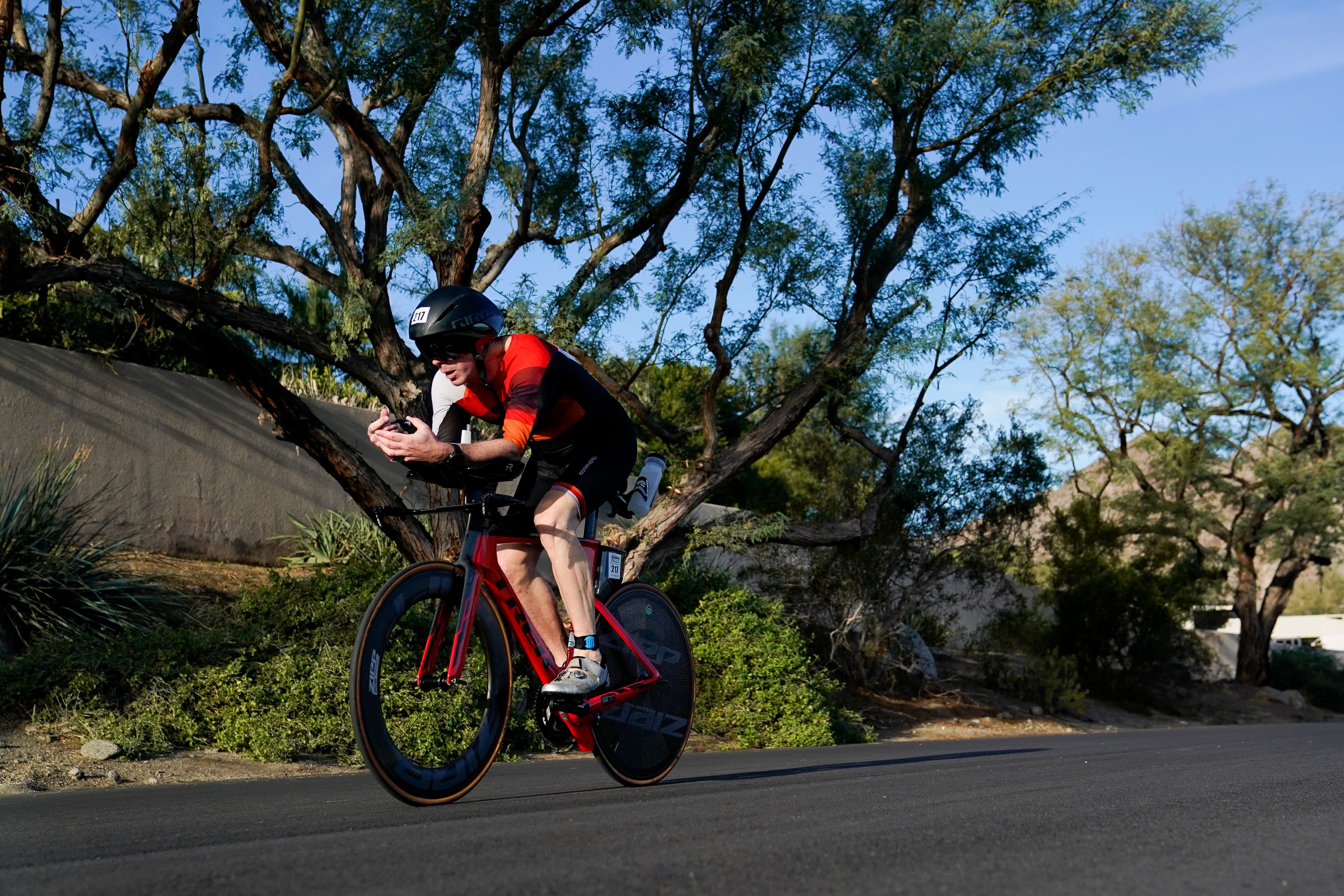
After exiting Transition 1 at Lake Cahuilla, the bike course guides riders through rural desert roads lined with palm tree farms. The crown jewel of this course is a full technical lap around the Thermal Raceway, a private motorsports track featuring ultra-smooth asphalt, slight banking, and sharp 90-degree and 180-degree turns. While the asphalt is pristine, the open desert terrain leaves riders highly exposed to unpredictable headwinds and crosswinds. Furthermore, the lack of elevation change means there are virtually no downhills to coast, requiring continuous, uninterrupted pedaling.

Training Implication

To handle this relentless IRONMAN 70.3 La Quinta course profile, your training must focus on isometric endurance and sustained aerodynamic posture.

  • No-Coasting Trainer Sessions: Integrate 90-minute indoor trainer workouts with zero coasting to build the muscular endurance required for constant pedaling.
  • Aero Position Holds: Implement core, lower back, and neck strength training to help you comfortably sustain a low aero profile against desert headwind stretches.
  • Technical Handling: Practice sharp, low-speed cornering and quick acceleration out of turns to maintain momentum through the raceway's technical sections.

Run Course

  • Distance: 13.1 miles (21.1 km), two-loop course
  • Elevation Profile: Gently undulating with ~196 feet (60 m) of total elevation gain
  • Terrain: Paved golf cart paths, with brief sections of grass and packed sand

The two-loop run takes place entirely within the SilverRock Golf Resort. While the course is highly spectator-friendly, it is deceptively taxing. The terrain consists of winding, concrete golf cart paths that weave through the fairways. These constant turns and minor, rolling ramps break up a runner's natural rhythm. Compounding this challenge is the environmental exposure: there is almost zero shade on the golf course, leaving athletes fully exposed to the dry, overhead desert sun as temperatures climb toward their afternoon peak.

Training Implication

Your run training must prepare your joints and cardiovascular system for hard surfaces and rhythm disruptions.

  • Hard-Surface Adaptation: Complete a portion of your long runs on concrete or hard paved paths to condition your joints to the pounding of the golf cart tracks.
  • Variable Cadence Work: Practice running drills that require you to quickly re-establish your target cadence after tight corners or short, steep ramps.
  • Heat Prep: Since the midday sun can feel intense against the dry air, incorporate progressive heat-acclimation sessions into your peak training weeks to prepare your body for running in direct, unshaded sunlight.

Training Phase Timeline

16 weeks

Base and Aerobic Foundation

Wk 14 · 4 wk

Muscular Endurance and Aero Progression

Wk 58 · 4 wk

Specific Preparation and Technical Skills

Wk 912 · 4 wk

Peak Volume and Simulation

Wk 1314 · 2 wk

Taper and Transition Logistics

Wk 1516 · 2 wk

Plan Overview

Welcome to your comprehensive road to La Quinta! This 16-week plan is specifically structured to address the highly unique environmental and logistical demands of this desert race. We begin with a strong Base and Aerobic foundation, introducing strength sessions to prep your body for holding a sustained aerodynamic tuck. Because the 56-mile bike course is exceptionally flat with only 564 feet of total climbing, you will have virtually no opportunities to coast. We build your muscular endurance in the second phase so your legs can handle continuous, uninterrupted pedaling. Concurrently, you will start early exposure to cold water to prepare your cardiovascular system for the notoriously chilly 56-60 degree Fahrenheit waters of Lake Cahuilla. As we move into the Specific and Peak phases, you will shift focus to race-pace brick workouts that target the undulating paved golf cart paths of the SilverRock Resort. While the run course features only 196 feet of total gain, the constant turns can disrupt your momentum, so we train you to establish a strong, resilient run cadence. This period is also where you will practice your hydration and fueling strategy. The dry desert air accelerates dehydration rapidly, and because there is zero shade on the golf course, practicing early hydration on the bike and utilizing ice at aid stations on the run will be critical to your success. In your final Taper phase, you will shed physical fatigue while keeping your neuromuscular systems sharp with short, fast intervals. You will also mentally prepare for the split-transition logistics, including the mandatory wetsuit decontamination protocol and the chilly morning shuttle. By tapering your volume while keeping your nutrition and hydration high, you will arrive at the start line fresh, fully loaded with glycogen, and ready to secure a personal record in the beautiful Coachella Valley.

Phase 1

Base and Aerobic Foundation

Wk 144 weeks

Building low-intensity aerobic volume, initiating core strength, and starting cold-water breathing adaptation.

Phase 2

Muscular Endurance and Aero Progression

Wk 584 weeks

Sustained flat-course pedaling efforts, aerodynamic posture holds, and run rhythm development.

Phase 3

Specific Preparation and Technical Skills

Wk 9124 weeks

Simulating desert crosswinds, sharp cornering practice, and dry-climate hydration strategies.

Phase 4

Peak Volume and Simulation

Wk 13142 weeks

Race-pace brick workouts, cold-water swim acclimatization, and multi-loop run strategy execution.

Phase 5

Taper and Transition Logistics

Wk 15162 weeks

Active recovery, sharpening short efforts, and finalizing dry-air hydration and split-transition logistics.

Race Day Execution

Maximize your performance in the Coachella Valley with this comprehensive IRONMAN 70.3 La Quinta race day strategy. Use these science-backed IRONMAN 70.3 La Quinta preparation tips to navigate the extreme temperature shifts, relentless flat bike course, and unique split-transition logistics of this desert race.


Weather & Climate Strategy

The desert environment demands a dual-temperature protocol. You will transition from freezing morning air to intense, dry afternoon heat.

  • Pre-Race Warmth: Wear old throwaway sweatpants and a long-sleeve shirt over your wetsuit for the cold morning shuttle ride and transition setup. Keep these on until minutes before entering the starting pen.
  • Thermal Shock Mitigation: Avoid hyperventilating in the chilly reservoir water by utilizing the designated "acclimation zone." Submerge your face, chest, and hands to trigger the mammalian dive reflex and stabilize your breathing before your swim start.
  • Dry Air Management: The exceptionally low humidity accelerates sweat evaporation, masking your actual sweat rate. Treat hydration as a math equation, not a sensation—drink on a strict schedule even if you feel completely dry.
  • Pre-Race Heat Prep: In the 2–3 weeks leading up to the race, incorporate 20-minute post-workout dry sauna sessions to trigger blood plasma volume expansion, helping your body regulate heat during the unshaded run.

Nutrition & Hydration Plan

Success at this venue depends entirely on executing an aggressive, early hydration strategy on the bike before the dry air compromises your blood volume.

  • Pre-Race Fueling Timeline:
    1. 3 Hours Before Start: Consume 100–150g of easy-to-digest carbohydrates (e.g., oatmeal with a banana or white bagels).
    2. 2 Hours Before: Drink 16–20 oz of water mixed with a high-sodium electrolyte formula (approx. 1,000mg sodium) to hyper-hydrate your vascular system.
    3. 15 Minutes Before: Take one Maurten gel with a few sips of water.
  • The Bike Leg Target: Aim for 60–90g of carbohydrates and 24–32 oz of fluid per hour. Target 700–1,000mg of sodium per hour. Because the bike is exceptionally flat, carry your nutrition in aero-mounted bottles to avoid breaking your aerodynamic position.
  • The Run Leg Target: Aim for 30–60g of carbs per hour using gels and on-course sports drinks. Sip water and electrolytes at every aid station.
  • Active Cooling: Put ice from the aid stations down your tri-suit and inside your hat. Keeping your core temperature down under the direct midday sun prevents cardiac drift and preserves your running pace.

Gear & Transition Setup

A split-transition race with high desert winds requires highly specific gear choices and setup protocols.

  • Swim Gear: Wear a full wetsuit, a neoprene swim cap under the official race cap, and neoprene booties to protect your extremities from the cold water. Opt for mirrored or polarized goggles to combat the blinding morning sun on the return loop of the swim.
  • Bike Gear: Choose a deep-section rear wheel but keep the front wheel profile moderate (e.g., 50–60mm) to maintain control through the exposed desert crosswinds.
  • T1 (Lake Cahuilla) Setup: Place a bright towel on the ground to wipe sand off your feet before putting on your bike shoes. Crucial Tip: Never roll your bike off the paved asphalt in transition. The surrounding dirt is infested with "goathead" sandburs that will instantly puncture your tires.
  • T2 (SilverRock Park) Setup: Lay out your running shoes with elastic speed laces, a high-reflectivity white running cap, sunglasses, and your run race belt. Double-check your T2 gear bag drop on Saturday, as you will not have access to it on Sunday morning.

Pacing & Mental Strategy

Avoid the temptation to over-pace the deceptively flat profile. Respecting the relentless nature of the terrain is key to a personal record.

Race Morning Timeline
  1. 4:00 AM: Wake up and consume your pre-race meal.
  2. 5:00 AM: Arrive at the designated parking area near SilverRock Park. Take the mandatory official athlete shuttle to T1 (no public driving/athlete drop-offs are allowed at Lake Cahuilla).
  3. 6:00 AM: Set up T1, pump tires, and drop off your morning clothes bag.
  4. 6:45 AM: Enter the swim acclimation zone to adapt to the water temperature.
Segment Pacing Strategy
  • Swim: Focus on a high-cadence, steady stroke. Keep your effort capped at a moderate aerobic zone to manage the cold-water response.
  • Bike: Maintain a steady, flat-course power target. Because there are no hills to coast down, keep constant pressure on the pedals. Use the technical corners at the motorsports track to stretch your lower back out of the aero tuck.
  • Run: Control your pace on the concrete cart paths during the first 3 miles. Keep your stride short and your cadence high to cushion your joints against the hard paved surfaces and winding turns.
Common Mistakes to Avoid
  • Over-cycling: The pancake-flat bike course tempts athletes to push high gears continuously. This burns out the quadriceps, leading to severe cramping on the run. Keep your cadence between 85–95 RPM.
  • Neglecting early hydration: Feeling cool on the bike can trick you into thinking you don't need to drink. Hydrate early and often.

Travel & Logistics

Navigating a split transition requires careful planning to eliminate race-week stress.

  • When to Arrive: Fly into Palm Springs International Airport (PSP) by Thursday morning. This allows you to complete the mandatory wetsuit decontamination protocol at Lake Cahuilla on Friday or Saturday without rushing.
  • Where to Stay: Book lodging in La Quinta or Indian Wells. Staying near SilverRock Park (T2/Finish Line) is highly recommended, as this is where you will park and board the shuttle on race morning.
  • Course Recon: Drive the bike route on Friday to observe wind patterns and visualize the entry into the Thermal Club. Walk a portion of the run path at SilverRock Resort to understand how the concrete paths curve and roll.

Your Personalized Training Plan

Your Personal Path to IRONMAN 70.3 La Quinta

While this guide provides a foundation, every athlete is unique. FE26 creates a personalized plan by analyzing:

  • Your Data: Seamless Strava integration to benchmark your current fitness.
  • Your Life: Training blocks that adapt to your real-world schedule.
  • The Course: Workouts specifically engineered for these unique race demands.
  • Your Recovery: Weekly adaptive periodization that adjusts targets based on your actual performance.

Stop guessing your intervals. Start training with a system that evolves with you.

Create Your IRONMAN 70.3 La Quinta Training Plan