IRONMAN 70.3 OmanTraining Plan & Race Guide 2027

Muscat, OmanFebruary 6, 202770.3 mi — Half Distance7 min read

Race & Course Analysis

As the host of the IRONMAN 70.3 Middle East Championship, Muscat offers a racing experience that blends the stark beauty of the Al Hajar Mountains with the pristine coastline of the Sea of Oman. This event is a "bucket list" race for athletes seeking a fast, high-quality course with a touch of exotic flair. It suits athletes who excel on rolling bike terrain and can maintain a high threshold in warm, sun-exposed conditions.

The race follows the standard 70.3-mile (113km) format: a 1.9km ocean swim, a 90km undulating bike leg, and a 21.1km flat run. While the run course is built for speed, the cumulative elevation on the bike and the intense desert sun during the second half of the race make it a true test of physical and mental endurance.

Swim Course

The race begins at Al Qurum Beach with a 1.9km single-loop swim in the Sea of Oman. The water is typically 23°C (73.4°F), which often places it on the borderline for wetsuit legality for age-group athletes. The rolling beach start helps to thin out the field early, providing a relatively calm experience in clear, salty water. While the sea is generally tranquil with minimal current, athletes should be prepared for a light morning swell.

  • Training Implication: Your training plan must emphasize open-water proficiency and sighting. Given the 23°C temperature, you should prepare for both wetsuit and non-wetsuit scenarios. Training in salt water, if possible, will help you adjust to the increased buoyancy, but the primary focus should be on building a strong aerobic engine to handle the 1.9km distance without fatigue before hitting the bike.

Bike Course

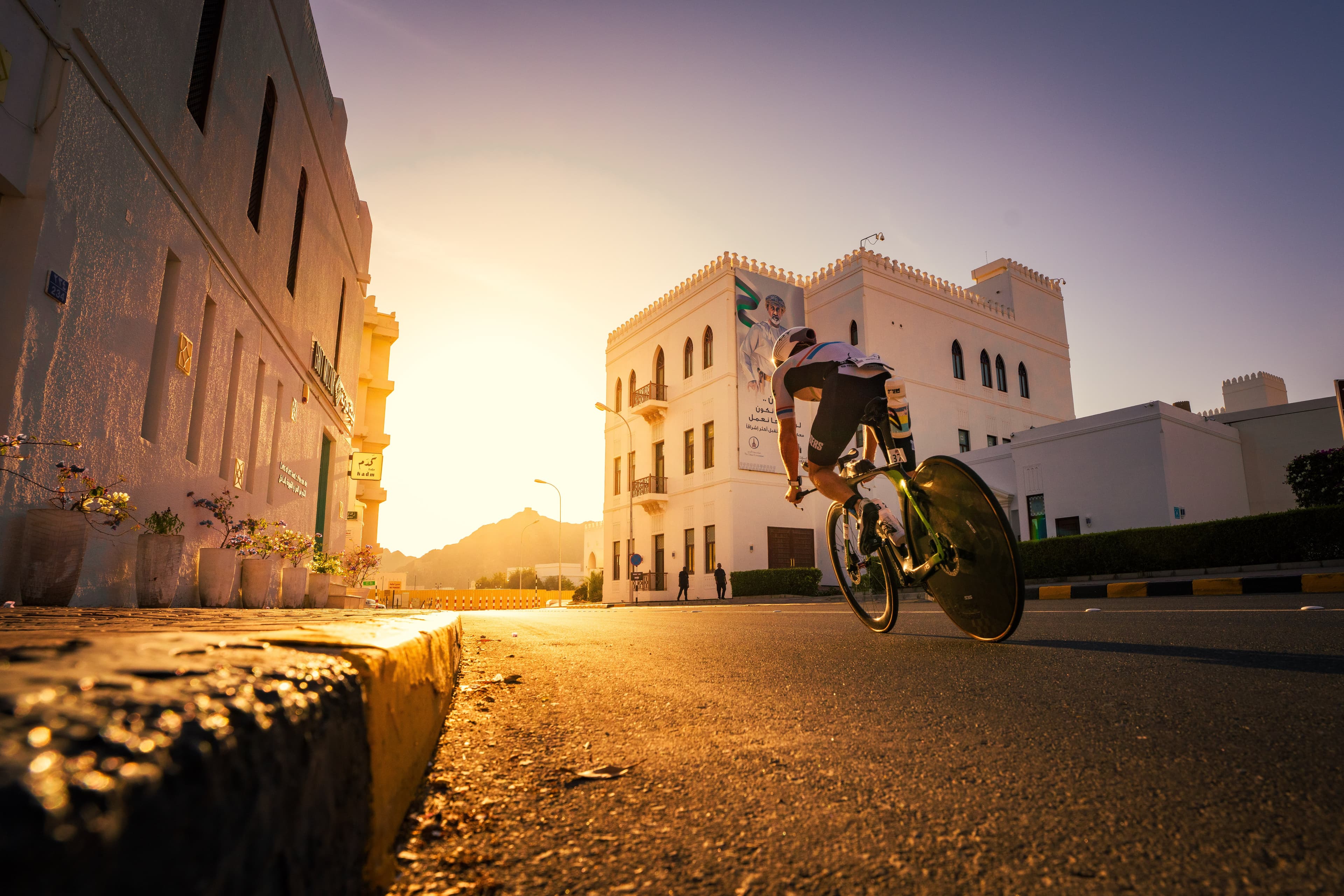
The 90km bike course is the centerpiece of the event, featuring approximately 800m of total vertical gain. It is a scenic, rolling loop that takes athletes past architectural landmarks like the Royal Opera House and the Mutrah Corniche. The defining feature is the Al Bustan climb—a 2.3km ascent with a 6.1% average grade and pitches exceeding 10%. The road surface is high-quality asphalt, though coastal crosswinds and headwind sections on the return stretches can significantly impact your effort.

  • Training Implication: This course demands specific strength-endurance. You should incorporate hill repeats and low-cadence strength work (50–60 RPM) into your bike sessions to mimic the Al Bustan climb. Since the course is "rolling," your training must include intervals that teach you how to maintain power over crests and recover on descents. Additionally, practicing in a time-trial (TT) position during windy conditions will prepare you for the coastal gusts.

Run Course

The 21.1km run is a fast, multi-lap course (typically three loops) through Qurum Natural Park and along the Shatti Al Qurum promenade. The terrain is almost entirely flat, consisting of asphalt and decorative tiles. While the profile suggests a personal best (PB) opportunity, the challenge lies in the environment. There is virtually no shade, and with temperatures rising toward 28°C (82°F) and a very high UV index, the heat becomes a major physiological factor.

  • Training Implication: To succeed on this course, heat adaptation is non-negotiable. As your training progresses, you should incorporate "brick" runs (running immediately after cycling) during the warmer parts of the day to simulate the 28°C race environment. Focus on maintaining a steady rhythm on flat terrain. Your training plan should also include sessions that practice the "cooling" mechanics of a race—using water and sponges to keep core temperatures down—as this will be your primary defense against the Omani sun.

By focusing your 16-week preparation on bike strength for the Al Bustan climb and thermal resilience for the run, you will be well-positioned to handle the unique demands of the IRONMAN 70.3 Oman course.

Training Phase Timeline

16 weeks

Aerobic Foundation

Wk 14 · 4 wk

Strength and Climbing

Wk 58 · 4 wk

Race-Specific Intensity

Wk 912 · 4 wk

Peak Volume

Wk 1314 · 2 wk

Taper and Sharpen

Wk 1516 · 2 wk

Plan Overview

You will begin your 16-week journey by establishing a solid aerobic foundation, ensuring your body is prepared for the 1.9km swim in the salt waters of the Sea of Oman and the 90km bike leg. As you move into the Build phase, you will specifically target the Al Bustan climb by incorporating hill repeats and low-cadence strength work. This ensures that when you hit those 10% gradients during the race, you have the power to crest them without burning through your matches. Your training will then shift toward the specific intensities required for a 70.3-mile event, focusing on sustained efforts that mimic the rolling hills of Muscat's high-quality asphalt roads. In the latter half of the plan, you will turn your attention to the unique environmental challenges of Oman. Even though the morning starts at a cool 18°C, you will practice your hydration strategy to handle the rapid rise to 28°C. You will incorporate heat-acclimation sessions to prepare for the flat, sun-exposed 21.1km run through Qurum Natural Park. Since the run course lacks shade, your brick sessions will focus on maintaining a steady rhythm while staying on top of your electrolyte intake, aiming for that critical 700-1000mg of sodium per hour to combat the high UV intensity. Finally, you will enter the Peak and Taper phases to ensure you arrive at Al Qurum Beach with maximum freshness and sharp mental focus. You will reduce your training volume while maintaining intensity, allowing your muscles to recover from the cumulative stress of the 800m vertical gain on the bike. This structure gives you the best chance to enjoy the scenic Mutrah Corniche and Royal Opera House as you race, confident that you have the endurance to cross the finish line and the strength to handle the Middle East Championship field.

Phase 1

Aerobic Foundation

Wk 144 weeks

Building a strong cardiovascular base and establishing swim technique for the Sea of Oman.

Phase 2

Strength and Climbing

Wk 584 weeks

Targeting the 800m bike elevation with hill repeats and strength-based bike intervals.

Phase 3

Race-Specific Intensity

Wk 9124 weeks

Simulating race-pace efforts and beginning heat adaptation for the 28°C afternoon sun.

Phase 4

Peak Volume

Wk 13142 weeks

Maximizing endurance and fine-tuning the 700-1000mg sodium per hour hydration strategy.

Phase 5

Taper and Sharpen

Wk 15162 weeks

Reducing volume to ensure fresh legs for the flat run and recovery from the Al Bustan climb.

Race Day Execution

IRONMAN 70.3 Oman Race Day Strategy

Success at the IRONMAN 70.3 Middle East Championship in Muscat requires more than just fitness; it demands a surgical approach to heat management and pacing. Use this execution guide to navigate the transition from the cool Arabian Sea to the intense desert sun.

Weather & Climate Strategy

The primary environmental challenge in Muscat is the rapid temperature shift and high UV exposure. While the morning begins at a comfortable 18°C (64°F), the intensity of the sun (UV index 8+) will be your biggest performance limiter during the second half of the race.

  • Heat Acclimation: Initiate a 10–14 day heat-adaptation protocol prior to arrival. Use 20-minute post-workout sauna sessions or controlled indoor rides in a warm room (without fans) to trigger plasma volume expansion.
  • On-Course Cooling: Do not wait until you feel hot. At every run aid station, take ice to put in your kit (chest and back) and use wet sponges on your head and neck to keep your core temperature down.
  • Skin Protection: Apply high-SPF, water-resistant sunscreen during your pre-race prep and consider a small "sunscreen stick" in T2 for a quick face/shoulder reapplication.

Nutrition & Hydration Plan

High sweat rates are common in Oman’s dry heat, often leading to dehydration before the athlete realizes they are thirsty.

  • Pre-Race Fueling: Aim for 500-700ml of electrolyte-rich fluid 2 hours before the start. Consume 1-1.2g of carbohydrates per kg of body weight for breakfast.
  • Sodium Targets: Target 700–1000mg of sodium per hour. Given the high sweat rate in the desert, relying on water alone can lead to hyponatremia.
  • Carbohydrate Intake: Aim for 60–90g of carbohydrates per hour on the bike, primarily through liquid or gel sources to aid absorption.
  • Front-Loading Strategy: Use the flatter sections of the bike course to aggressively hydrate. It is significantly easier to absorb fluids on the bike than during the sun-exposed run.

Gear & Transition Setup

Your equipment choices should prioritize ventilation and the specific mechanical demands of the rolling Muscat terrain.

  • Swim Gear: With water temperatures hovering around 23°C (73.4°F), bring both a wetsuit and a swim skin. Be prepared for a last-minute "wetsuit optional" ruling for age groupers.
  • Bike Setup: Ensure your gearing can handle 10% gradients comfortably; a 30T or 32T rear cassette is recommended to keep your cadence high on the Al Bustan climb. Use a well-ventilated aero helmet rather than a fully closed "long-tail" version to prevent overheating.
  • Run Gear: Opt for a white or light-colored cooling visor and moisture-wicking apparel. Elastic laces are essential for quick T2 exits.

Pacing & Mental Strategy

Muscat is a "fair" course that rewards those who exercise restraint during the first two hours.

  • Swim Pacing: Utilize the rolling beach start to find a clear line. Focus on long, efficient strokes; the calm Sea of Oman is perfect for finding a steady rhythm early.
  • Bike Execution: Treat the Al Bustan climb as a "controlled effort." Avoid spiking your power into the anaerobic zone; save those matches for the return headwind sections and the run.
  • The "Sun-Exposed" Run: The run course offers little shade. Mentally break the multi-lap course into "aid-station-to-aid-station" segments. Focus on maintaining a high cadence (85-90 spm) to minimize muscle damage on the flat asphalt.
  • Common Mistake: Over-cycling the rolling hills. It is easy to burn too much glycogen on the scenic coastal undulations, leaving nothing for the heat of the half-marathon.

Travel & Logistics

Oman offers a world-class athlete experience, but logistics require early planning for a stress-free race week.

  • Arrival Timeline: Aim to arrive in Muscat at least 3–4 days before the race. This allows you to adjust to the GST (Gulf Standard Time) and conduct a course recon.
  • Location & Stay: The InterContinental or Crowne Plaza are the premier choices for proximity to the Al Qurum Beach transition area.
  • Course Recon: If possible, drive the bike loop on Thursday or Friday. Pay close attention to the descent after the main climb and identify potential crosswind sections along the coastal roads.
  • Transport: Muscat is a car-centric city. Use the "Otaxi" app for reliable, fixed-price transport if you do not have a rental car. All major bike shops in Muscat offer mechanical support and assembly services if pre-booked.

Your Personalized Training Plan

Your Personal Path to IRONMAN 70.3 Oman

While this guide provides a foundation, every athlete is unique. FE26 creates a personalized plan by analyzing:

  • Your Data: Seamless Strava integration to benchmark your current fitness.
  • Your Life: Training blocks that adapt to your real-world schedule.
  • The Course: Workouts specifically engineered for these unique race demands.
  • Your Recovery: Weekly adaptive periodization that adjusts targets based on your actual performance.

Stop guessing your intervals. Start training with a system that evolves with you.

Create Your IRONMAN 70.3 Oman Training Plan