IRONMAN 70.3 Pennsylvania Happy ValleyTraining Plan & Race Guide 2026
State College, United StatesJune 14, 202670.3 mi — Half Distance2 min readPublished April 5, 2026Updated July 23, 2026
Share
01·Course Characteristics
The measure of Happy Valley
A deceptively fast reservoir swim gives way to a challenging point-to-point bike featuring a relentless three-mile mountain climb. You must save your legs for the undulating, sun-exposed campus run to finish strong at Beaver Stadium.
Climate
27°C
Peak air · water 23-24.5°C · mid-June
Conditions
Exposed
Valley crosswinds · low shade on run · high humidity risk
Elevation
1097 m
Bike gain · 3-mile climb · rolling run terrain
Difficulty
7.5 / 10
The calm reservoir swim belies a highly challenging, hilly bike course with over 1000 m of climbing, followed by a relentless, undulating run in direct sun.
This edition has passed
Training for a future IRONMAN 70.3 Pennsylvania Happy Valley?
Registration for the next edition opens on a rolling basis. Start building your base now and we'll size a full plan the moment a new date is set.
This single-loop, clockwise triangular swim takes place in a quiet, clean freshwater reservoir with excellent sighting conditions and minimal currents. The course features a straight 700m opening leg, a sharp right-hand turn, and a matching 700m leg before the final turn back. Expect some congestion around the tight turn buoys due to the rolling self-seeded beach start.
02
Bike
Valley Rollers and Peaks
Bald Eagle State Park to Beaver Stadium
DISTANCE
90 km
LOOPS
Point-to-point
ELEVATION
1097 m
TERRAIN
Rolling with 1 major climb
WIND
8-16 km/h crosswinds
The point-to-point ride transitions from scenic, rolling farmlands into a series of punchy climbs after mile 20. The signature challenge is a steady 5% average gradient, 4.8 km ascent up Centre Hall, peaking with 7-9% pitches. A strict speed limit is enforced on the technical descent before a final, deceptive 8 km uphill drag to Beaver Stadium.
03
Run
The Nittany Lion Loop
Penn State University Campus
DISTANCE
21.1 km
LOOPS
2 loops
ELEVATION
170 m
SURFACE
Asphalt and concrete
SHADE
Minimal
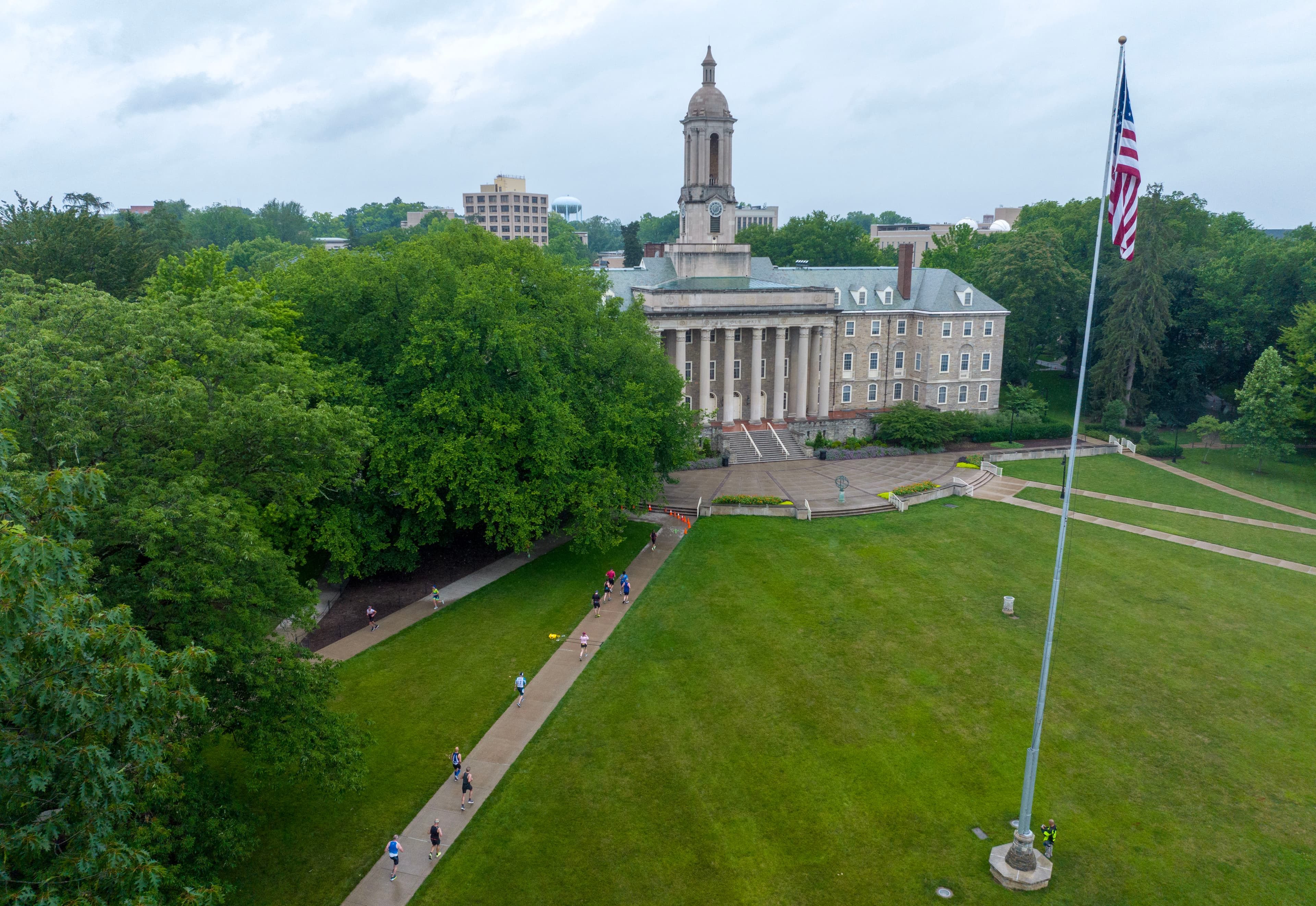
A fully paved, double-loop course that winds through the Penn State University campus, finishing spectacularly inside Beaver Stadium. The route is highly undulating with a total gain of up to 170 m, featuring frequent twists, turns, and short out-and-backs. Natural shade is minimal, meaning peak afternoon temperatures can feel extremely intense.
03·AVG beginners' Training Timeline
From zero to the finish line
16 weeks
This 16-week progression is specifically tailored to the demanding topography of Happy Valley. It starts with building a robust aerobic base before systematically introducing high-torque climbing intervals to master the bike course's 1097 m elevation gain. Finally, it integrates brick runs on hard surfaces and heat-adaptation protocols to prepare you for the exposed campus run.
Today · WK 0Race Day
WK 1–5
Base & Aerobic Capacity
Establish a strong aerobic foundation and swimming endurance in comfortable conditions.
WK 6–10
Strength & Progressive Climbing
Build specific muscular endurance to manage the 1097 m bike climbing load and punchy rollers.
WK 11–14
Race-Specific Build & Heat Adaptation
Integrate brick runs on undulating paved paths and initiate heat-acclimation protocols.
WK 15–16
Taper & Logistics Preparation
Reduce training volume to shed fatigue while sharpening race-pace efficiency and logistics planning.
Adapts to your fitness, schedule & recovery every week.
Expect highly variable temperatures, rising from 13°C at dawn to a peak of 27°C in direct sun with potential humidity and afternoon storms. Utilize every run aid station to douse yourself with water and stuff ice down your tri-suit to actively control core temperature spikes.
Fuel & hydration
Aim for 60-90g of carbohydrates and 500-1000ml of fluids per hour, using the flatter first 32 km on the bike to fuel before the climbs. Pre-load electrolytes prior to race day to mitigate sweat losses exacerbated by regional humidity and direct sun exposure.
Pacing
Pace yourself conservatively during the first 32 km of the bike to preserve energy for the Hubler Ridge rollers and the Centre Hall climb. Do not burn matches on the 5% mountain ascent, and save strength for the final 8 km uphill drag and the undulating run.
Gear & logistics
This is a split-transition race requiring meticulous planning as T1 and T2 are 25 minutes apart. Drop off your run gear bag at T2 on Saturday, pack both a wetsuit and a sleeveless swimskin for borderline 24.5°C waters, and catch the early morning athlete shuttle to T1.
Frequently Asked Questions
How hard is the IRONMAN 70.3 Pennsylvania Happy Valley bike course?
This bike course is exceptionally challenging, earning a 7.5 out of 10 difficulty rating with 3,200 to 3,600 feet of total climbing. The point-to-point route starts flat-to-rolling for the first 20 miles before hitting punchy rollers and a continuous 3-mile, 5% average gradient climb up to Centre Hall/Mount Nittany Observatory. You will need to pace yourself carefully early on to save your legs for these climbs and the final 5-mile uphill drag toward Beaver Stadium.
What is the water temperature and wetsuit policy for the IRONMAN 70.3 Pennsylvania Happy Valley swim?
The water temperature in the Foster Joseph Sayers Reservoir historically averages 74°F to 76°F (23°C to 24.5°C). While the swim is typically wetsuit-legal, the temperature frequently hovers very close to the USAT wetsuit cutoff of 76.1°F (24.5°C). It is highly recommended that you pack both a sleeveless wetsuit to prevent overheating and a backup swimskin in case the water temperature exceeds the legal limit.
How does the split transition work at IRONMAN 70.3 Pennsylvania Happy Valley?
Because this is a point-to-point race, T1 is located 25 minutes away at Bald Eagle State Park and T2 is at Penn State's Beaver Stadium. You must meticulously plan your logistics by checking your Red Run Gear Bag into T2 on Saturday before driving to Bald Eagle State Park to check in your bike. On race morning, you will park at Beaver Stadium and ride the athlete shuttles to the swim start, so be sure to leave early to avoid morning traffic delays.
What is the run course profile like for the Happy Valley 70.3?
The 13.1-mile run is a rolling, double-loop course on fully paved asphalt and concrete paths winding through the Penn State University campus. You will face frequent twists, turns, and approximately 500 to 560 feet of total elevation gain on highly fatigued legs. Since natural shade is minimal and campus roads are exposed to the sun, utilizing the aid stations every mile to douse yourself with ice is crucial for managing your core temperature.
What nutrition and hydration strategy should I use for the Pennsylvania Happy Valley 70.3?
On the bike, aim to consume 60 to 90 grams of carbohydrates and 500 to 1,000 ml of fluids per hour, utilizing the flatter first 20 miles to fuel before the heavy climbing begins. For the run, take advantage of the aid stations placed every mile, which offer Maurten gels, solids, Gatorade, water, and ice. Due to regional humidity, pre-loading electrolytes before the race is highly recommended to prevent cramping on the hilly terrain.
Your Personalized Plan
Stop guessing your intervals. Train for this course.
FE26 builds your plan around your Strava data, your real schedule, and the exact demands of IRONMAN 70.3 Pennsylvania Happy Valley— then adapts every week to how you actually perform.