All Race Guides

IRONMAN 70.3 SwitzerlandTraining Plan & Race Guide 2026

Rapperswil-Jona, SwitzerlandJune 7, 202670.3 mi — Half Distance7 min read

Race & Course Analysis

Nestled at the northern end of Lake Zurich, IRONMAN 70.3 Switzerland Rapperswil-Jona is one of Europe’s most storied endurance events. Known for its "Swiss precision" and a spectator-heavy atmosphere, the race offers a perfect blend of alpine beauty and a technical, honest challenge. This event is a playground for the well-rounded triathlete: it rewards those who can navigate a technical bike course with significant vertical gain and still maintain a fast cadence on a flat but rhythm-breaking run.

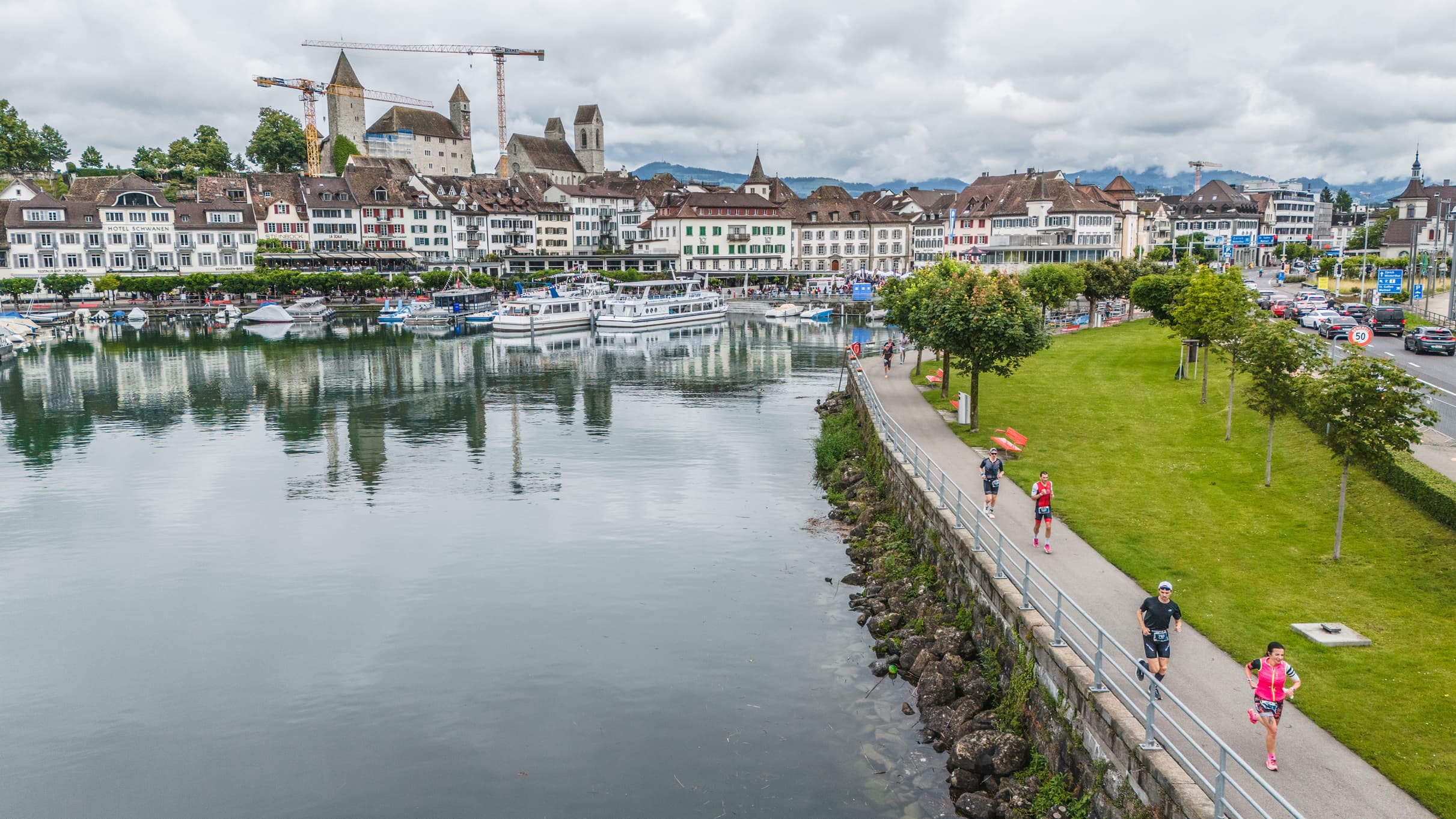
The 113km (70.3-mile) journey consists of a 1.9km single-loop swim in the crystal-clear Obersee, a grueling 90km two-loop bike course through the hills of St. Gallen, and a 21.1km two-loop run that passes through the medieval old town and along the lakefront. With the race set for June 7, 2026, athletes should prepare for a course that tests muscular endurance and bike-handling skills above pure flat-line speed.

IRONMAN 70.3 Switzerland Course Analysis

Effective preparation for Rapperswil requires more than just accumulating mileage; it demands a training plan built around the specific vertical and technical profile of the Swiss landscape.

Swim Course

The 1.9km (1.2-mile) swim takes place in the Obersee, the upper part of Lake Zurich. The course is a single-loop rectangular layout, known for its predictable and calm waters. With average water temperatures ranging between 17°C and 19°C (63-66°F), the swim is almost always wetsuit-legal. The rolling start format helps mitigate congestion, allowing athletes to settle into their stroke quickly.

  • Key Challenges: While the water is calm with minimal current, sighting can occasionally be tricky if the early morning sun reflects off the water's surface. The water clarity is excellent, which helps with navigation but provides little visual stimulation, making mental focus key.
  • Training Implication: Your training should prioritize aerobic efficiency and sighting technique. Because the water is predictable, you won't need to prepare for heavy chop, but you should practice "crocodile sighting" every 6-8 strokes to maintain a straight line between the well-marked buoys.

Bike Course

The 90km bike course is the defining feature of IRONMAN 70.3 Switzerland. Consisting of two 45km loops, it features a total elevation gain of approximately 1,100 meters (3,600 ft). The course is famous for two primary climbs per loop: the "Witch’s Hill" (Hexenberg) and the long ascent to Goldingen. The Hexenberg is short but punishing, with gradients spiking over 10 percent. Conversely, the descent from Goldingen is fast and technical, demanding confidence at high speeds.

  • Key Challenges: The sheer volume of climbing (1,100m) is the primary obstacle. Sustaining high-power outputs on the steep Hexenberg can easily "overcook" the legs for the second loop and the run. Additionally, the technical descents require sharp bike-handling skills on high-quality asphalt.
  • Training Implication: Your IRONMAN 70.3 Switzerland training plan must include high-torque intervals and hill repeats. Focus on building muscular endurance to handle 10%+ gradients without crossing your anaerobic threshold. Incorporating technical descending practice is also vital to "gain time for free" while recovering between the climbs.

Run Course

The 21.1km (13.1-mile) run is a two-loop course that is largely flat as it skirts the shores of Lake Zurich. However, its reputation is built on the "Stairway to Heaven"—a steep climb up the stone steps of the Rapperswil Castle. This climb occurs once per loop, totaling a 120m elevation gain for the run. The terrain is a mix of fast asphalt and historic cobblestones through the medieval old town.

  • Key Challenges: The "Stairway to Heaven" acts as a major rhythm disruptor. Climbing steep steps mid-run forces a shift in muscle recruitment that can lead to cramping or a loss of pace once you return to the flat lakeside paths.
  • Training Implication: To master the run, you must train for the muscular transition after the stairs. Incorporate stair-climb drills or rapid step-ups immediately followed by race-pace intervals during your brick runs. This teaches your neuromuscular system to recover quickly from the high-intensity vertical effort of the castle steps and return to a steady aerobic rhythm.

By aligning your 16-week build with these specific Swiss demands, you will ensure that you arrive in Rapperswil-Jona with the strength to conquer the Hexenberg and the resilience to survive the Stairway to Heaven.

Training Phase Timeline

16 weeks

Aerobic Foundation & Strength

Wk 14 · 4 wk

Climbing Power & Force

Wk 58 · 4 wk

Course Specificity

Wk 912 · 4 wk

Peak Intensity

Wk 1314 · 2 wk

Taper & Strategy

Wk 1516 · 2 wk

Plan Overview

You will begin this journey by building a robust aerobic engine and the structural integrity needed for the Swiss hills. Because the bike course features 1,100 meters of climbing across two loops, early phases focus on high-torque intervals and posterior chain strength. This ensures that when you hit the 10 percent gradients of the 'Witch’s Hill' (Hexenberg), you have the muscular reserve to power through without overcooking your legs for the run. You will progress from general fitness to specific power, gradually introducing climbing sessions that mimic the repetitive nature of the Goldingen ascent.

As the race approaches, you will shift your focus to the unique technical demands of the Rapperswil-Jona course. You will practice technical descending to navigate the fast Goldingen sections safely and efficiently. Crucially, your training will simulate the 'Stairway to Heaven.' By adding stair-specific work into your brick runs, you will teach your body to handle the rhythm disruption caused by the Rapperswil Castle steps. Since Lake Zurich is typically calm and wetsuit-legal, your swim sessions will focus on efficiency and sighting to ensure you exit the water fresh and ready for the challenging bike leg ahead.

Phase 1

Aerobic Foundation & Strength

Wk 144 weeks

Building a solid aerobic base and foundational strength to handle the upcoming vertical load.

Phase 2

Climbing Power & Force

Wk 584 weeks

Increasing FTP and muscular endurance specifically for the 1,100m of bike elevation and steep gradients.

Phase 3

Course Specificity

Wk 9124 weeks

Simulating race-day efforts, including technical descents and 'Stairway to Heaven' muscular transitions.

Phase 4

Peak Intensity

Wk 13142 weeks

Refining race-pace efforts in Lake Zurich-like conditions and sharpening the run rhythm.

Phase 5

Taper & Strategy

Wk 15162 weeks

Reducing volume to shed fatigue while finalizing the Maurten-based nutrition plan and mental focus.

Race Day Execution

IRONMAN 70.3 Switzerland Race Day Strategy

Executing a successful race in Rapperswil-Jona requires a balance of Swiss precision and tactical patience. While the course is breathtaking, the technical bike leg and the unique muscular demands of the run require a specific execution framework.

Weather & Climate Strategy

The Swiss climate in June is generally athlete-friendly, but the temperature range requires versatility.

  • Layering for the Bike: Morning starts can be crisp (approx. 15°C). Consider a lightweight, packable gilet or arm warmers for the first bike loop. You can easily stow these as the temperature rises toward 24°C.
  • Sun Management: The run course along the lake embankment is highly exposed. Apply high-quality, water-resistant sunscreen in T2, even if it feels overcast, as the UV index at this time of year is high.
  • Acclimation: If traveling from a significantly cooler or hotter climate, arrive at least three days early. While humidity is moderate, the change in air density can affect your perceived exertion on the climbs.

Nutrition & Hydration Plan

The 1,100m of elevation gain on the bike dictates your fueling windows. Use the flatter sections near the lake to front-load your calories.

  1. Caloric Targets: Aim for 60–90g of carbohydrates per hour on the bike. Use the descents and flatter valley sections to ingest solids or high-viscosity gels, as the high-intensity climbs like Hexenberg will make swallowing difficult.
  2. The Maurten Factor: The course provides Maurten products. Ensure your "gut training" in the final weeks of your IRONMAN 70.3 Switzerland preparation tips includes these specific hydrogel formulas to avoid GI distress on race day.
  3. Sodium Load: If the temperature exceeds 22°C, increase sodium intake to 700–1,000mg per hour. The "Stairway to Heaven" creates an eccentric loading pattern on the quads and calves that can trigger cramping if your electrolyte balance is off.
  4. Pre-Race Fueling: Consume a carbohydrate-rich, low-fiber meal 3 hours before the swim start. Sip 500ml of an electrolyte mix in the 90 minutes leading up to the rolling start.

Gear & Transition Setup

Rapperswil’s technical nature favors gear that prioritizes handling and power transfer over pure aerodynamics.

  • Gearing: Ensure your bike is fitted with a 30T or 32T cassette. Even strong climbers will appreciate the extra teeth on the 10%+ gradients of Hexenberg to keep the cadence above 75 RPM and save the legs for the run.
  • Wheel Choice: A mid-depth wheelset (45mm–60mm) is ideal. Deep-section wheels can be twitchy on the fast, technical Goldingen descent if a breeze picks up off the lake.
  • T1/T2 Logistics: The transition area near Knies Kinderzoo is long. Use a bright towel or a distinct marker for your rack. Remember that Swiss transition areas are notoriously clean and strict—keep your gear neatly tucked in your designated box to avoid penalties.

Pacing & Mental Strategy

Success in Switzerland is won by those who respect the second loop of the bike and the stairs on the run.

  • Swim: With the rolling start, seed yourself honestly. Sighting is easy, so find a fast pair of feet and stay in the draft to save energy for the 1,100m of climbing ahead.
  • Bike Pacing: Do not chase watts on the steep climbs. Cap your intensity at 90-95% of FTP on the Hexenberg to avoid accumulating a massive oxygen debt. Your goal is a "negative split" effort—be conservative on loop one so you can pass fading athletes on loop two.
  • The Run Rhythm: The "Stairway to Heaven" will spike your heart rate. Do not attempt to "run" the steps at full tilt. Use a high-cadence power-hike or short, rapid steps, and use the subsequent flat lakeside section to settle your breathing back into a rhythm.
  • Mistakes to Avoid: Avoid "burning matches" by trying to maintain speed on the technical descents. Use the descents for recovery and micro-fueling instead.

Travel & Logistics

Switzerland’s infrastructure makes this one of the easiest races to navigate, provided you plan for the "Swiss price tag."

  • Arrival: Aim to arrive by Thursday. Fly into Zurich (ZRH) and take the S7 or S5 train directly to Rapperswil. The SBB rail system is the most bike-box-friendly transport in the world.
  • Accommodation: If Rapperswil is fully booked, look at stays in Pfäffikon (just across the bridge) or even Zurich. The S-Bahn train makes commuting to the start line seamless and stress-free.
  • Course Recon: If possible, drive or ride the Goldingen descent on Friday. Knowing the apex of the corners will give you the confidence to stay off the brakes on race day, saving seconds of "free time."

Your Personalized Training Plan

Your Personal Path to IRONMAN 70.3 Switzerland

While this guide provides a foundation, every athlete is unique. FE26 creates a personalized plan by analyzing:

  • Your Data: Seamless Strava integration to benchmark your current fitness.
  • Your Life: Training blocks that adapt to your real-world schedule.
  • The Course: Workouts specifically engineered for these unique race demands.
  • Your Recovery: Weekly adaptive periodization that adjusts targets based on your actual performance.

Stop guessing your intervals. Start training with a system that evolves with you.

Create Your IRONMAN 70.3 Switzerland Training Plan