IRONMAN 70.3 Venice-JesoloTraining Plan & Race Guide 2026
Jesolo, ItalyMay 3, 202670.3 mi — Half Distance2 min readPublished April 2, 2026Updated July 4, 2026
Share
01·Course Characteristics
Speed and Wind in Venice-Jesolo
An exceptionally flat course that trades climbing for constant pedaling, coastal wind exposure, and a three-loop run with a hot, sun-drenched seaside half.
Climate
22°C
Peak air · water 16-18°C · early May
Conditions
Exposed
Coastal sea breezes · high humidity · sun-exposed promenade
Elevation
45 m
Flat bike profile · 7-20 m run gain · zero major climbs
Difficulty
4 / 10
Structurally flat and fast, but demands relentless pedaling without coasting, alongside open coastal winds and a half-exposed run.
This edition has passed
Training for a future IRONMAN 70.3 Venice-Jesolo?
Registration for the next edition opens on a rolling basis. Start building your base now and we'll size a full plan the moment a new date is set.
A single counter-clockwise loop in the Adriatic Sea starting and finishing at Lighthouse Beach. The sandy-bottom waters are typically calm, though mild tidal currents can occur.
02
Bike
Lagoon Speed Loop
Lido di Jesolo to Eraclea
DISTANCE
90 km
LOOPS
1 loop
ELEVATION
45 m
SURFACE
Paved asphalt
WIND
7-12 mph breeze
An incredibly flat single loop passing through Cavallino-Treporti along the scenic Venetian Lagoon. The long, straight roads are perfect for time-trialing, but fully exposed to coastal crosswinds and headwinds.
03
Run
The Promenade Triple
Lighthouse Beach Promenade
DISTANCE
21.1 km
LOOPS
3 loops
ELEVATION
7-20 m
SURFACE
Paved and concrete
SHADE
Partial
PEAK TEMP
19-22°C
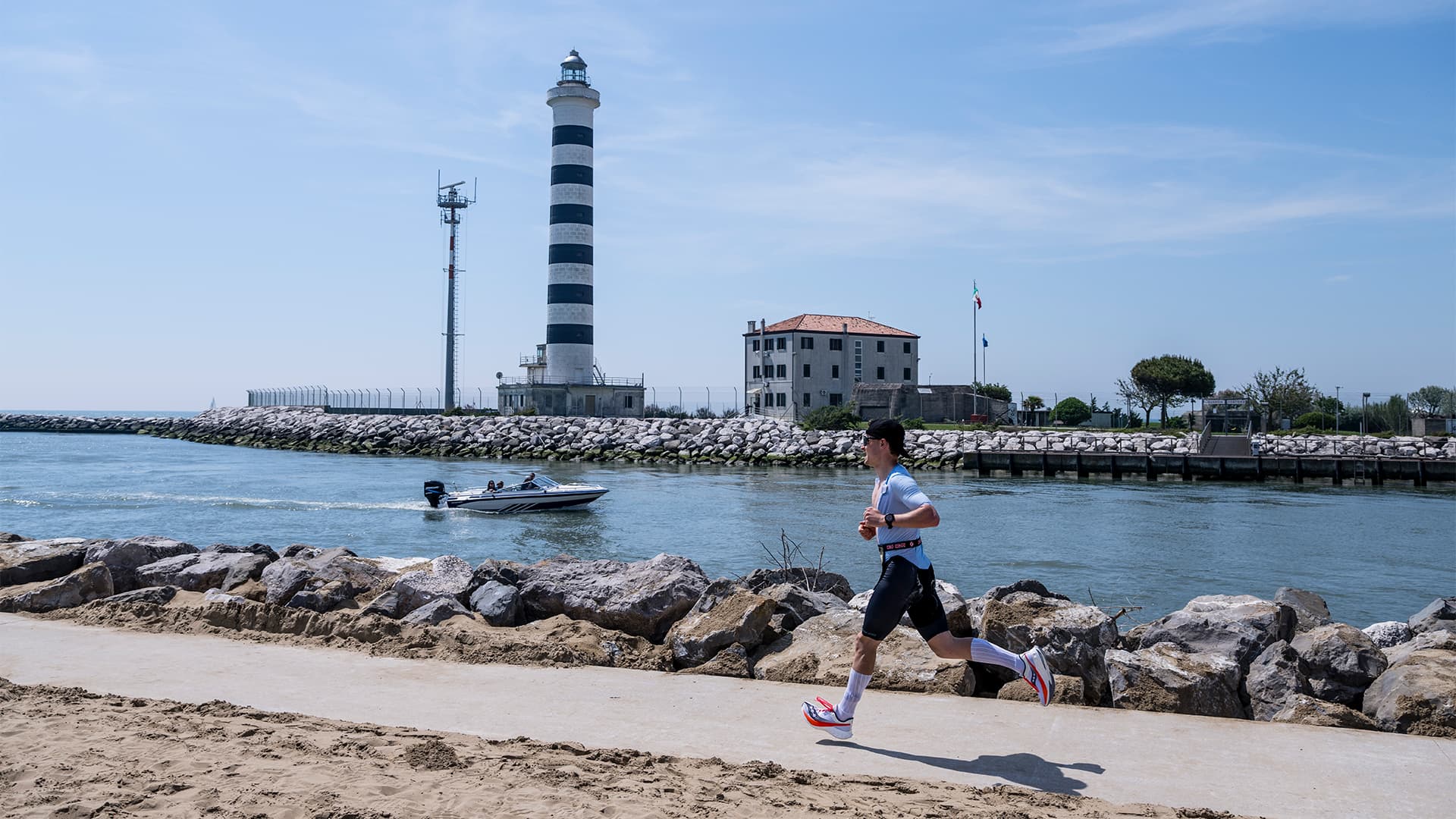
A flat, three-loop run where each lap splits between a shaded tree-lined street and a fully exposed, sun-drenched concrete seaside promenade, finishing on the beach sand.
03·AVG beginners' Training Timeline
From zero to the finish line
16 weeks
This 16-week plan targets the unique muscular endurance needed for Jesolo's relentless flat terrain. Because you cannot coast, we build robust lower back and hip durability early, alongside open-water pacing, ending with specific heat and wind simulations.
Today · WK 0Race Day
WK 1–4
Aerobic Foundation
Build basic aerobic capacity and swim stamina in calm waters.
WK 5–8
Sustained Power & Aero Durability
Develop core strength and hip flexor endurance for continuous flat pedaling.
WK 9–12
Race-Specific Speed & Wind Prep
Incorporate longer time-trial efforts and brick runs to simulate transitioning to flat running.
WK 13–16
Peak & Taper
Sharpen race-pace efforts in simulated conditions and taper to ensure fresh muscles.
Adapts to your fitness, schedule & recovery every week.
Prepare for morning temperatures around 11-13°C rising to 19-22°C. Use the shaded halves of the run loops to recover, and douse yourself with cold water at every aid station during the exposed seaside segments.
Fuel & hydration
The flat bike allows for highly consistent, structured feeding; aim for 60-90g of carbs per hour. Due to 70-75% humidity, consume electrolytes regularly to prevent cramping and offset sweat loss.
Pacing
Avoid over-pedaling early on the flat bike; the constant effort can silently fatigue your hip flexors. Keep an even power output through headwinds, and maintain a disciplined, steady pace on the flat run.
Gear & logistics
Arrive early to walk the 1 km distance from transition at Viale Gorizia to the swim start at Lighthouse Beach. Bring a wetsuit for the 16-18°C water and prepare for crosswinds by selecting a manageable front wheel depth.
Frequently Asked Questions
What is the water temperature and wetsuit policy for the IRONMAN 70.3 Venice-Jesolo swim?
The expected water temperature in the Adriatic Sea in early May ranges from 16°C to 18°C (60.8°F to 64.4°F). This means the 1.9 km swim is highly likely to be wetsuit-legal for age group athletes, and potentially mandatory if the water falls below 16°C. The swim itself is a single counter-clockwise loop starting and finishing at Lighthouse Beach with a sandy bottom and typically calm conditions.
How flat is the bike course at IRONMAN 70.3 Venice-Jesolo?
The single-loop 90 km bike course is exceptionally flat, featuring a total elevation gain of only 45 to 72 meters (147 to 238 feet). While the straight, high-quality asphalt roads are built for hitting personal bests, the lack of downhills requires constant, continuous pedaling with zero coasting, which can fatigue your hip flexors and lower back. Additionally, you must be prepared for wind exposure, as coastal and lagoon-side sections are highly vulnerable to crosswinds and headwinds.
What is the run course layout like for IRONMAN 70.3 Venice-Jesolo?
The run is a flat, 3-loop half marathon totaling 21.1 km with minimal elevation gain of only 7 to 20 meters. Each 7.03 km loop begins on a pleasantly shaded, tree-lined street before transitioning onto a concrete seaside promenade that is fully exposed to the sun and wind. The run concludes with a dramatic finish line directly on the sand at Lighthouse Beach.
What weather conditions should I expect on race day in early May?
You should prepare for moderate coastal weather, with cool morning temperatures around 11°C to 13°C (52°F to 55°F) at the swim start rising to afternoon highs of 19°C to 22°C (66°F to 72°F) during the run. Relative humidity typically ranges between 70% and 75%, and you will likely encounter gentle to moderate sea breezes of 7 to 12 mph blowing off the Adriatic Sea. Cloud cover is historically mixed, presenting a combination of partly cloudy and sunny intervals.
How far is the transition area from the swim start at Venice-Jesolo?
The single transition area (T1/T2) at Viale Gorizia/Udine is located approximately 1 kilometer (0.75 miles) away from the registration and swim start at Lighthouse Beach. This translates to about a 10-11 minute walk, so you should complete a dry run of this walk on Saturday to ensure your race morning logistics go smoothly. Be sure to account for this distance when planning your pre-race timeline.
Your Personalized Plan
Stop guessing your intervals. Train for this course.
FE26 builds your plan around your Strava data, your real schedule, and the exact demands of IRONMAN 70.3 Venice-Jesolo— then adapts every week to how you actually perform.