IRONMAN 70.3 WarsawTraining Plan & Race Guide 2026
Warsaw, PolandJune 7, 202670.3 mi — Half Distance2 min readPublished April 9, 2026Updated July 23, 2026
Share
01·Course Characteristics
The Speed of Warsaw
A lightning-fast point-to-point course starting in Lake Zegrzyńskie and finishing in the historic heart of Warsaw. Your primary challenge is managing a flat, sustained bike effort and pacing the multi-loop run in warm June conditions.
Climate
23°C
Average June high · water 17-19°C · wetsuit likely
Conditions
Flat
Point-to-point bike · sheltered run · moderate wind risk
Elevation
180 m
Total bike gain · pancake flat · rapid rolling speed
Difficulty
3.5 / 10
Highly accessible, ultra-flat profile. The main challenge lies in sustaining a continuous aerodynamic posture on the bike without natural terrain breaks.
This edition has passed
Training for a future IRONMAN 70.3 Warsaw?
Registration for the next edition opens on a rolling basis. Start building your base now and we'll size a full plan the moment a new date is set.
The swim takes place in the calm, clean waters of Lake Zegrzyńskie, located north of Warsaw. Sighting is straightforward in this wide reservoir, which typically features minimal current or chop under normal June conditions.
02
Bike
The High-Speed Corridor
Zegrze to Warsaw Point-to-Point
DISTANCE
90 km
LOOPS
Point-to-point
ELEVATION
180 m
TERRAIN
Pancake flat
SURFACE
Smooth asphalt
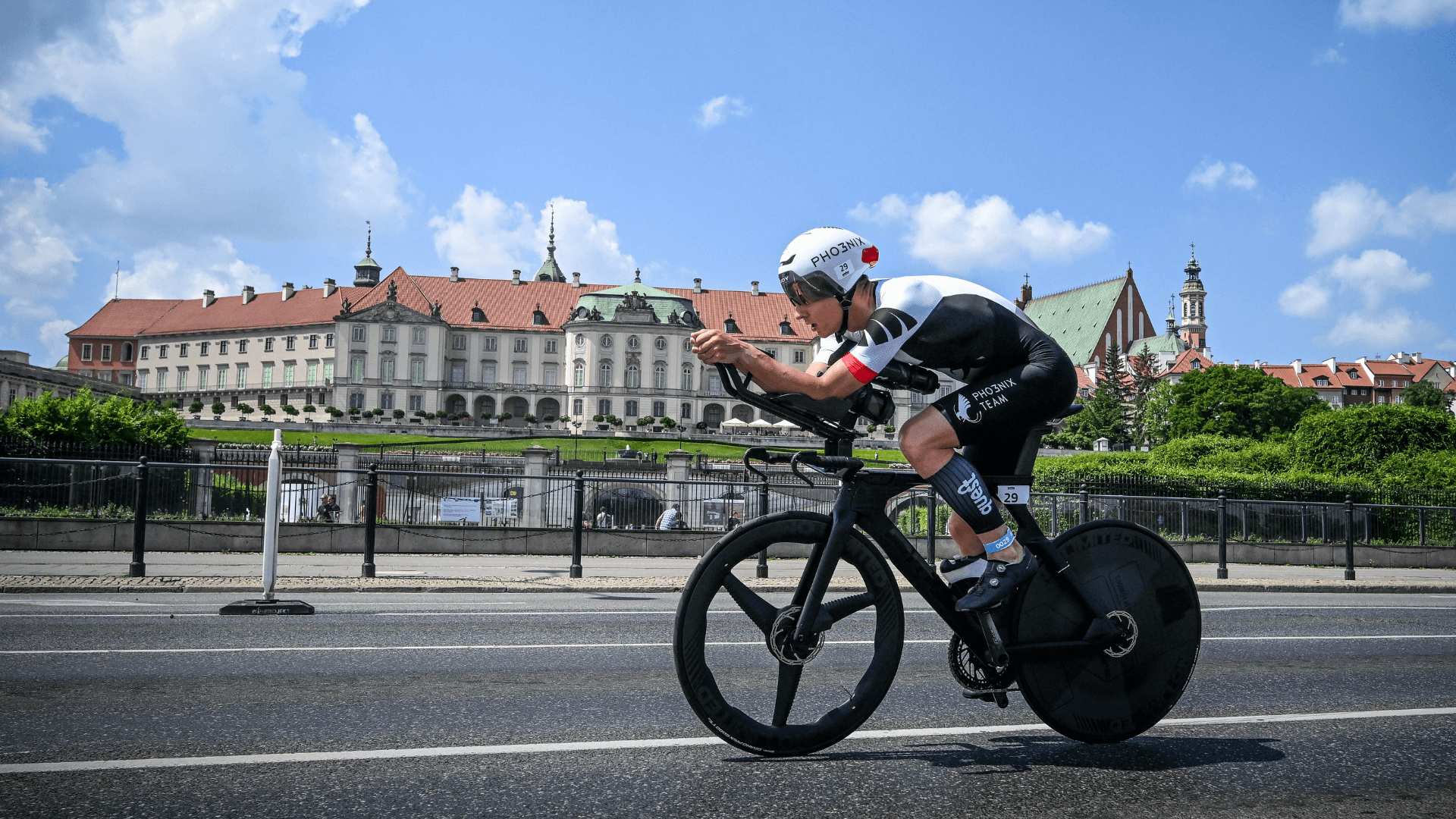
An incredibly flat, fast point-to-point route that takes you south from the lake directly into the center of Warsaw. With almost zero elevation gain, you must stay tucked in your aero bars and maintain steady, unrelenting power.
03
Run
The Historic Loop
Warsaw Old Town & Vistula Boulevard
DISTANCE
21.1 km
LOOPS
2 loops
ELEVATION
120 m
SURFACE
Asphalt & cobblestones
SHADE
Partial
A scenic multi-loop run taking you along the Vistula River boulevards and past Warsaw's historic Old Town. The course is mostly flat, but includes a brief, sharp incline on each lap to transition near the historic city walls.
03·AVG beginners' Training Timeline
From zero to the finish line
16 weeks
This 16-week plan is customized for Warsaw's ultra-flat, high-speed profile. By prioritizing sustained aerobic power and aero-position durability early, you will comfortably handle the relentless pedaling on the bike and finish strong on the historic Warsaw run.
Today · WK 0Race Day
WK 1–5
Aerobic Aerodynamic Base
Build foundational aerobic capacity and core strength to comfortably support the aero position.
WK 6–10
Flatline Sustained Power
Develop sustained flat-road power and introduce run-off-the-bike bricks.
WK 11–14
Race-Specific Intensity
Maximize race-pace efficiency and practice complete hydration and fueling protocols.
WK 15–16
Taper & Sharpen
Drop training volume to shed cumulative fatigue while keeping neuromuscular systems active.
Adapts to your fitness, schedule & recovery every week.
June in Warsaw can range from mild to surprisingly warm, with midday temperatures occasionally exceeding 25°C. Utilize every aid station for cold water over your head and shoulders, and wear a white, breathable race suit to reflect solar radiation.
Fuel & hydration
Because the flat bike course demands constant pedaling with no coasting, plan a highly consistent fueling strategy of 80-90g of carbohydrates and 600-800ml of fluids per hour. Do not neglect hydration early on the bike simply because the air feels cool near the lake.
Pacing
Maintain a disciplined power cap on the flat bike leg; it is easy to over-torque early on these fast roads. On the run, pace yourself conservatively through the first loop, reserving extra energy for the sharp climb up to the Old Town.
Gear & logistics
Opt for a deep-section front wheel and a rear disc wheel to maximize aerodynamic efficiency on this flat course. Note that transition 1 is at Lake Zegrzyńskie and transition 2 is in downtown Warsaw, so organize your gear bags carefully the day before.
Frequently Asked Questions
What is the swim course like for IRONMAN 70.3 Warsaw?
The swim takes place in Lake Zegrzyńskie, located just north of Warsaw, which is known for its calm and clean waters. Because the race is held in early June, water temperatures typically hover around 18°C to 20°C (64°F to 68°F), making it highly likely to be a wetsuit-legal swim. You will swim a single-loop 1.9 km course before heading to transition 1 (T1) situated right on the lake's shore.
How flat is the IRONMAN 70.3 Warsaw bike course?
The 90 km bike course is exceptionally flat, fast, and scenic, featuring a net downhill trajectory as it points from Lake Zegrzyńskie toward the heart of Warsaw. With less than 150 meters of total elevation gain, it is a prime course for setting a personal best, though you should prepare for potential headwinds or crosswinds on the exposed open roads. The route is fully closed to traffic and brings you directly to Transition 2 (T2) next to the Multimedia Fountain Park.
What should I expect on the IRONMAN 70.3 Warsaw run course?
The 21.1 km run is a flat, spectator-friendly multi-loop course that winds through the historic streets of Warsaw, including the Old Town and the Vistula River boulevards. You will run on a mix of asphalt and cobblestone sections, which requires stable footwear and mindful foot placement. The course is lined with enthusiastic crowds and concludes with a high-energy finish line experience next to the Multimedia Fountain Park.
Is IRONMAN 70.3 Warsaw a point-to-point race?
Yes, this race utilizes a split-transition, point-to-point layout, meaning Transition 1 is located at Lake Zegrzyńskie where the swim occurs, while Transition 2 is situated 30 kilometers away in downtown Warsaw. You will need to organize your gear bags accordingly during athlete check-in and utilize the official race shuttles to navigate between the venue sites. Planning your logistics a day in advance is highly recommended to ensure a stress-free race morning.
What is the typical weather for IRONMAN 70.3 Warsaw in June?
In early June, Warsaw generally experiences mild and pleasant spring-to-summer transition weather, with average daytime temperatures ranging from 15°C to 23°C (59°F to 73°F). Rain is always a possibility in Poland during this season, so you should pack gear suitable for both damp conditions and bright sunshine. Because the run course offers limited shade along the Vistula River, wearing a hat, sunglasses, and sunscreen is highly advisable.
Your Personalized Plan
Stop guessing your intervals. Train for this course.
FE26 builds your plan around your Strava data, your real schedule, and the exact demands of IRONMAN 70.3 Warsaw— then adapts every week to how you actually perform.