IRONMAN 70.3 Western AustraliaTraining Plan & Race Guide 2026
Busselton, AustraliaDecember 6, 202670.3 mi — Half Distance2 min readPublished July 1, 2026Updated July 4, 2026
Share
01·Course Characteristics
The speed of Western Australia
An ultra-flat course offering massive speed potential, but the lack of hills demands non-stop pedaling and absolute discipline against coastal headwinds and intense sun on the exposed run.
Climate
27°C
Peak air temperature · water 19-22°C · early December
Conditions
Exposed
Coastal headwinds · intense UV · zero shade on run
Elevation
105 m
Bike gain · ultra-flat · continuous pedaling required
Difficulty
4.5 / 10
Flatness simplifies cardio pacing, but continuous pedaling in aero and an exposed, hot coastal run increase physical fatigue.
There's still hope!
Only 9 weeks to go — but it's not too late.
The ideal build for this course is 16 weeks, and you have 9. We'll compress the essentials into your remaining time, prioritizing the demands that matter most on this course to get you to the finish line.
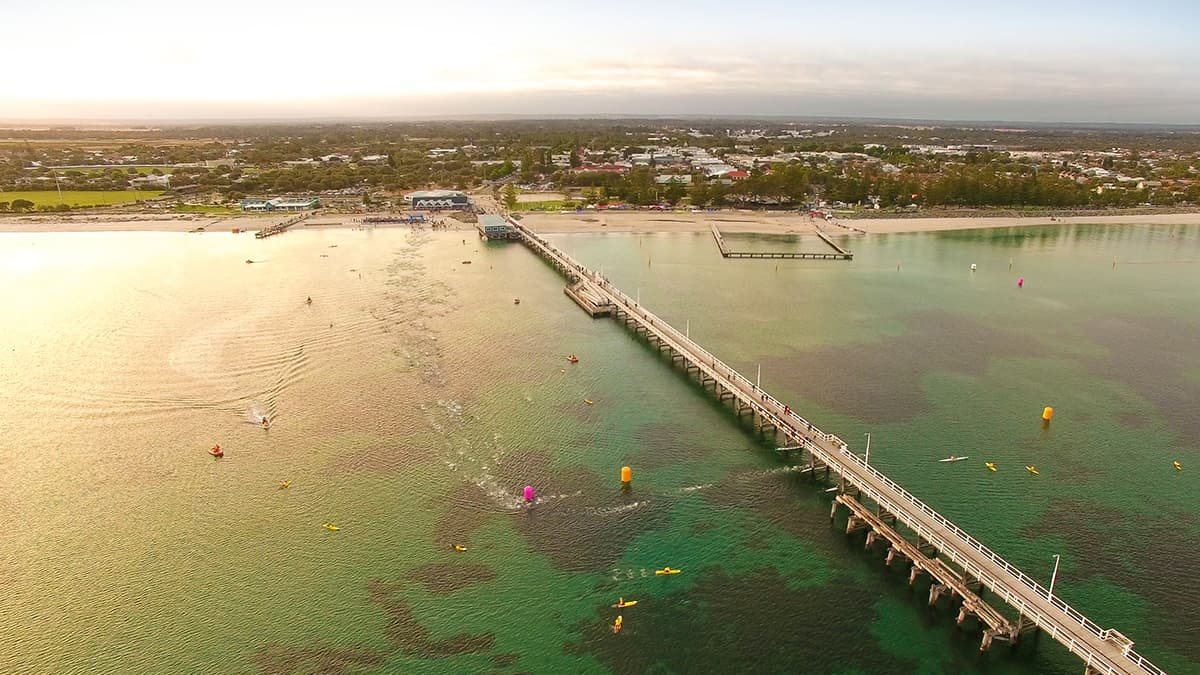
A rolling beach-start swim in the exceptionally clear, protected waters of Geographe Bay. You will swim perpendicular to the shore before turning to pass directly beneath the historic Busselton Jetty pylons, enjoying high underwater visibility throughout.
02
Bike
Flat and Fast Forest Loop
Signal Park to Tuart Forest
DISTANCE
90 km
LOOPS
1-loop
ELEVATION
105 m
SURFACE
High-quality asphalt
WIND
Strong coastal breezes
SHADE
Partial in forest
A remarkably flat single-loop course transitioning from the Busselton coastline into the shaded Tuart Forest before returning. Strong coastal headwinds and crosswinds will challenge your progress, and the lack of hills means you must pedal continuously without coasting.
03
Run
The Exposed Foreshore
Busselton Foreshore and Geographe Bay
DISTANCE
21.1 km
LOOPS
2-loop
ELEVATION
13 m
SURFACE
Paved pathways
SHADE
None
PEAK TEMP
27°C
A completely flat, two-loop coastal run along the Busselton Foreshore that passes the iconic jetty and finish line at Signal Park. The path is fully exposed to the midday sun and strong coastal winds, meaning high temperatures can quickly elevate your core heat.
03·AVG beginners' Training Timeline
From zero to the finish line
16 weeks
This 16-week plan is specifically engineered to address Busselton's unique challenges. Since the course is incredibly flat, the plan shifts focus away from climbing strength and heavily prioritizes isometric muscular endurance for continuous aero riding, heat adaptation, and pacing against coastal headwinds.
Today · WK 0Race Day
WK 1–5
Aerobic Base Building
Develop a solid endurance foundation with steady, low-intensity swims, rides, and runs.
WK 6–10
Aero Tolerance & Strength
Build isometric core strength and endurance to tolerate long, continuous periods in the aero position.
WK 11–14
Specific Wind & Speed Build
Introduce race-pace intervals with simulated wind resistance and high-cadence brick sessions.
WK 15–16
Taper & Heat Prep
Reduce training volume while maintaining intensity and implementing heat-exposure training.
Adapts to your fitness, schedule & recovery every week.
Prepare for intense UV and temperatures peaking around 27°C by midday. Use every single aid station to dump cold water and ice over your head and shoulders to actively suppress your core temperature.
Fuel & hydration
Consume 60-90g of carbohydrates and 600-900ml of fluids and electrolytes per hour on the bike. Wind can mask sweat loss, so drink consistently and don't neglect fuel in the final 20km of the bike.
Pacing
Avoid over-biking on the deceptively flat roads; hold a steady, conservative power output despite headwinds. Save your energy for the exposed run, where pacing must account for the intense coastal heat.
Gear & logistics
Opt for deep-section wheels only if you are comfortable handling sudden, strong coastal crosswinds. Arrive early at Signal Park, which hosts a single transition area, and pack plenty of water-resistant sunscreen.
Frequently Asked Questions
What is the water temperature and wetsuit policy for the IRONMAN 70.3 Western Australia swim?
The water temperature in Geographe Bay typically ranges from 19°C to 22°C (66°F to 72°F), making wetsuits legal in most years. You will swim a protected, calm 1.9km single-loop course featuring a beach start that takes you underneath the historic Busselton Jetty.
How flat is the IRONMAN 70.3 Western Australia bike course?
This is one of the flattest and fastest courses in the world, featuring an exceptionally low elevation gain of only 103m to 106m (338ft to 348ft) over the 90km loop. However, because there are no hills to coast down, you must pedal continuously in an aero position, which can lead to significant muscle stiffness if you do not train for sustained efforts.
What are the typical weather conditions on race day in Busselton?
You can expect clear, warm conditions with morning temperatures starting around 16°C (61°F) and reaching midday highs between 23°C and 27°C (73°F to 81°F). The intense Australian sun is accompanied by strong coastal winds of 10 to 15 mph that typically develop during the bike and run legs.
What is the run course like for the Busselton 70.3?
The run is a highly flat, two-loop 21.1km course along the paved pedestrian pathways of the Busselton Foreshore with just 13m (44ft) of total elevation gain. While the flat terrain is fast, it has zero shade, meaning you must actively manage your core temperature by utilizing water and ice at the aid stations to combat the midday heat.
How should I plan my travel and logistics for IRONMAN 70.3 Western Australia?
Most athletes fly into Perth Airport (PER) and take a scenic 2.5-hour drive (220 km) south to Busselton, though some domestic flights land directly at Busselton Margaret River Airport (BQB). Because the event is highly popular, you should book beachfront accommodation early and plan to utilize the single transition area at Signal Park for a seamless race-day setup.
Your Personalized Plan
Stop guessing your intervals. Train for this course.
FE26 builds your plan around your Strava data, your real schedule, and the exact demands of IRONMAN 70.3 Western Australia— then adapts every week to how you actually perform.