BrazilMay 31, 2026140.6 mi — Full Distance2 min readPublished April 5, 2026Updated July 4, 2026
Share
01·Course Characteristics
The measure of IRONMAN Brazil
This flat, lightning-fast course invites personal records but demands strict tactical discipline. You must conquer deceptively high relative humidity, coastal highway wind exposure, and eight short, punchy climbs across the bike leg.
Climate
25°C
Peak air · water 20-22°C · late May
Conditions
Humid
Atlantic headwind · high humidity · no run shade
Elevation
1,119 m
Bike gain · rolling · eight short steep climbs
Difficulty
6 / 10
Fast but challenging due to 91% humidity, highway winds, and eight steep climbs.
This edition has passed
Training for a future IRONMAN Brazil?
Registration for the next edition opens on a rolling basis. Start building your base now and we'll size a full plan the moment a new date is set.
A two-loop, M-shaped course in calm, beach-protected waters with a 75-meter Australian-style beach run on the sand. Watch out for a parallel right-to-left current that strengthens in the final 500 meters, and steer clear of submerged rocks in the last 100 meters.
02
Bike
SC-401 Highway Speedway
Jurerê Internacional to Florianópolis
DISTANCE
180 km
LOOPS
2 loops
ELEVATION
1,119 m
TERRAIN
Rolling with steep pitches
SURFACE
Mostly smooth asphalt
WIND
Coastal head/tailwind
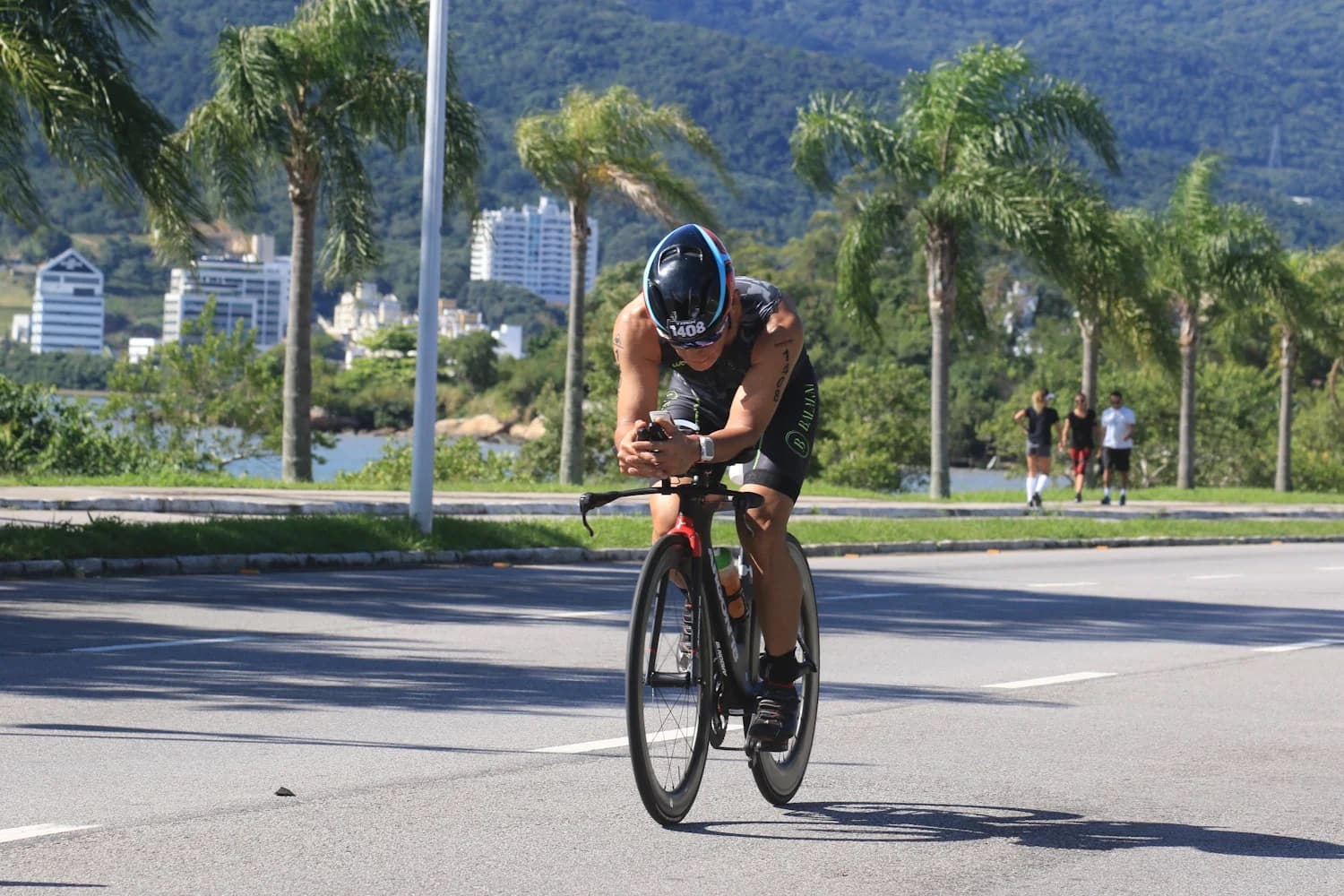
A fast two-loop course along the SC-401 highway where you can spend 95% of the time in the aero tuck. However, each loop features four short, punchy climbs with gradients up to 12% and a brief cobblestone section near transition.
03
Run
Jurerê Boulevard Marathon
Jurerê Internacional
DISTANCE
42.2 km
LOOPS
4 loops
ELEVATION
74 m
SURFACE
Asphalt and concrete
SHADE
None
PEAK TEMP
22-25°C
An exceptionally flat and fast 4-loop run course winding through upscale neighborhoods with high spectator energy. It is highly exposed to the sun during the day, though temperatures drop rapidly toward 16°C after sunset.
03·AVG beginners' Training Timeline
From zero to the finish line
24 weeks
Your 24-week arc starts with building a robust aerobic base before developing the specific leg strength needed for the short, steep highway climbs. The final blocks focus heavily on sustained aero-position efficiency and heat management to ready you for Florianópolis.
Today · WK 0Race Day
WK 1–8
Aerobic Foundation
Build aerobic capacity and baseline durability for the full distance volume.
WK 9–16
Strength & Punchy Climbing
Develop cycling power to easily manage the short, steep 12% highway climbs.
WK 17–21
Specific Endurance & Pacing
Refine long, flat aero position holding and run pacing under simulated high humidity.
WK 22–24
Taper & Strategy
Shed cumulative fatigue while sharpening speed and executing nutrition plans.
Adapts to your fitness, schedule & recovery every week.
High humidity up to 91% means sweat doesn't evaporate easily. Dump water and ice over your head at aid stations, and wear light-colored apparel to combat the exposed run course heat.
Fuel & hydration
High relative humidity demands diligent sodium and fluid replacement to prevent cramping. Consume solid foods or gels on the four steep climbs per bike loop when you are sitting up to stretch.
Pacing
Remain disciplined on the long flat highway stretches and avoid over-cycling on the four short, steep climbs. Save energy for the flat run, keeping in mind that strong coastal head/tailwinds can quickly change pacing dynamics.
Gear & logistics
Choose deep-section aero wheels but stay cautious on high-speed highway descending, especially in the common late-May rains. Arrive by Tuesday or Wednesday to complete a test swim at Ammo Beach and test the local currents.
Frequently Asked Questions
What is the water temperature and wetsuit policy for the IRONMAN Brasil swim?
Water temperatures in Jurerê Bay average between 20°C and 22°C (68°F to 71.6°F), meaning wetsuits are almost always legal for age-group athletes. The swim is held in calm, beach-protected waters with an M-shaped layout, featuring a 75-meter Australian-style beach run on the sand between its two loops. You should sight carefully in the final 100 meters to avoid submerged rocks and account for a superficial North-to-South current near transition.
How hard is the Nubank Ultravioleta IRONMAN Brasil bike course?
The bike course is highly regarded as one of the fastest in the world, with athletes spending about 95% of their time tucked in the aerodynamic position on the smooth asphalt of the SC-401 highway. However, it earns a 6/10 difficulty rating because each of the two loops features four short, punchy climbs of 1 to 1.5 km with gradients up to 12%, alongside potential headwind-tailwind transitions. You must also navigate a technical cobblestone section when entering the transition area in Jurerê.
What is the run course profile and elevation for IRONMAN Brasil?
The run course is exceptionally flat and fast, featuring a cumulative elevation gain of just ~74 meters (243 feet) over the 26.2-mile marathon. It is a highly energetic 4-loop layout that winds entirely on paved asphalt and concrete sidewalks through the upscale neighborhoods of Jurerê Internacional. While the route has virtually no natural shade and midday temperatures can reach 25°C (77°F), the late May sun is lower in the sky and conditions cool down rapidly to 16°C (60°F) after sunset.
How should I manage my nutrition and hydration during IRONMAN Brasil?
Because relative humidity is consistently high at 80% to 91%, your sweat rate can be deceptively high even in mild temperatures, making diligent sodium and fluid replacement paramount. On the bike, use the four short climbs per loop to sit up, stretch your lower back, and easily consume gels or solid foods since you will be tucked aero on the flat highway sections. During the run, take advantage of water cups and ice available at aid stations spaced every 2 to 2.5 km to help cool your core.
When should I arrive in Florianópolis and where should I stay?
You should aim to arrive by Tuesday or Wednesday before the May 31, 2026 race to adjust to travel, complete athlete check-in, and do a practice swim at Ammo Beach to gauge the local current. It is highly recommended to stay directly in Jurerê Internacional or neighboring Canasvieiras, which allows you to walk to the transition area, Expo, and local restaurants. Flying into Hercílio Luz International Airport (FLN) leaves you with a convenient 35 to 45-minute drive to the race venue.
Your Personalized Plan
Stop guessing your intervals. Train for this course.
FE26 builds your plan around your Strava data, your real schedule, and the exact demands of IRONMAN Brazil— then adapts every week to how you actually perform.