IRONMAN OmanTraining Plan & Race Guide 2026

Muscat, OmanDecember 5, 2026140.6 mi — Full Distance7 min read

Race & Course Analysis

IRONMAN Oman Course Profile & Training Guide

The IRONMAN Oman in Muscat offers one of the most visually stunning yet physically demanding courses in the Middle East. Scheduled for December 5, 2026, this full-distance event—consisting of a 3.8 km (2.4-mile) swim, 180 km (112-mile) bike, and 42.2 km (26.2-mile) run—is a world-class test of endurance.

This race suits athletes who thrive in warm climates and possess a strong power-to-weight ratio to conquer rolling topography. Because of the unique environmental variables and terrain, succeeding here requires a highly targeted IRONMAN Oman training plan that balances early-season aerobic capacity with late-stage heat adaptation.


Swim Course: Sea of Oman

  • Distance: 3.8 km (2.4 miles)
  • Water Type: Saltwater, open ocean
  • Temperature: Typically ranges between 23°C and 25°C (73°F–77°F)
  • Format: Rolling beach start

The swim takes place in the pristine, warm waters of the Sea of Oman. The course layout is typically a two-loop configuration starting from the sandy beaches of Muscat. While the bay offers some protection, athletes can expect moderate rolling swells and chop depending on coastal wind conditions. The warm water temperature often makes this a borderline or non-wetsuit swim for age-groupers.

  • Key Challenges: Sighting in the early morning sun glare can be highly disorienting. Additionally, the warm saltwater increases buoyancy but can accelerate chafing around the neck and underarms.
  • Training Implication: Your early training must prioritize high-volume aerobic swimming to build mitochondrial density and upper-body fatigue resistance. Incorporate open-water swim practices that emphasize bilateral breathing to adapt to sun glare and swell direction, alongside pool sets designed to build a strong, consistent swim cadence without relying on the buoyancy of a wetsuit.

Bike Course: Muscat Hills and Al Jissah

  • Distance: 180 km (112 miles)
  • Terrain: Rolling coastal roads with steep, punchy climbs
  • Elevation Profile: Moderately hilly, featuring the iconic Al Jissah pass
  • Road Quality: High-quality, smooth asphalt

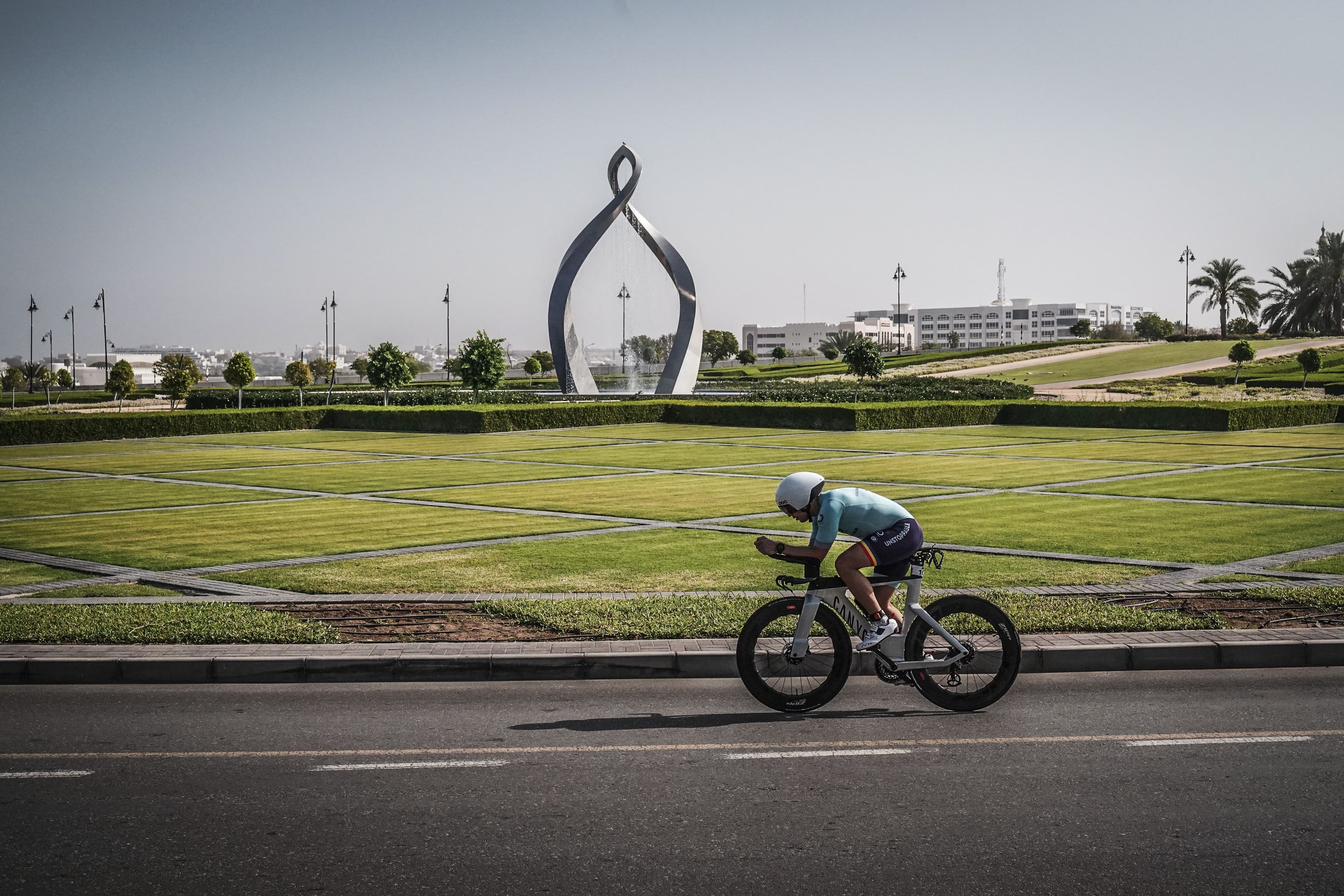
The bike course is a multi-loop route that showcases Muscat’s striking contrast between rugged mountains and scenic coastlines. The defining feature of this course is its rolling topography. Athletes will face sustained, high-gradient climbs—most notably the Al Jissah pass—which demand immediate, high-torque efforts. The roads are wide and well-paved, but highly exposed to both the intensifying desert sun and strong headwinds.

  • Key Challenges: The primary hazard is over-cycling on the steep climbs. Burning too many "matches" on the early hills will severely compromise your ability to run a marathon in the heat later in the day.
  • Training Implication: To prepare your legs for the IRONMAN Oman course profile, transition your training from flat, aerobic riding to low-cadence strength efforts (50–60 RPM) and progressive hill repeats. This builds the specific torque capability required to climb efficiently without overloading your cardiovascular system, preserving your glycogen stores for the run.

Run Course: Exposed Coastal Loops

  • Distance: 42.2 km (26.2 miles)
  • Terrain: Flat, paved coastal paths and roads
  • Elevation: Negligible
  • Exposure: Direct, unshaded sun exposure

The marathon consists of multi-loop coastal segments run alongside Muscat’s waterfront. While the terrain is flat and fast underfoot, the environmental conditions make this run exceptionally brutal. By the time athletes transition to the run, temperatures regularly exceed 30°C (86°F) with high coastal humidity. There is virtually no shade, meaning athletes are directly exposed to solar radiation for the entirety of the leg.

  • Key Challenges: The combination of radiant heat from the asphalt and high humidity severely limits the body's natural evaporative cooling, leading to rapid cardiac drift and elevated core temperatures.
  • Training Implication: Physical conditioning alone is not enough; your physiology must adapt to heat stress. Integrate a dedicated heat-acclimation protocol starting 3 to 4 weeks prior to the race. This should include 30-to-40-minute active sweat sessions in a sauna or hot bath immediately following your key workouts. These sessions expand your blood plasma volume, lower your resting core temperature, and improve your sweating efficiency, allowing you to sustain your target race pace under the blazing Muscat sun.

Training Phase Timeline

24 weeks

Aerobic Foundation

Wk 18 · 8 wk

Strength & Climbing Prep

Wk 914 · 6 wk

Race-Specific & Heat Prep

Wk 1519 · 5 wk

Peak & Simulation

Wk 2022 · 3 wk

Taper & Travel

Wk 2324 · 2 wk

Plan Overview

Welcome to your roadmap to conquering IRONMAN Oman! This 24-week plan is meticulously structured to progress you from a solid fitness baseline to peak race readiness. You will start with an 8-week Aerobic Foundation phase, focusing on low-intensity, high-volume training to build your mitochondrial density and structural durability. This is followed by a Strength and Climbing phase where you will tackle hill repeats and sustained efforts. This climb-focused work is critical for Muscat’s bike course, which features demanding rolling hills and steep climbs, such as the Al Jissah pass. Preparing your legs for these climbs early ensures you won't burn too many matches before you even hit the run. --- As we enter the Race-Specific and Peak phases, the focus shifts heavily toward heat prep and race-pace simulation. You will practice long ride-to-run transitions (bricks) under simulated or actual warm conditions. Since Muscat’s run course is notoriously hot and humid, your body must adapt to cooling itself efficiently while maintaining a steady pace. You will also practice your salt and fluid intake meticulously, aiming to match the high sweat rates you will experience on Muscat's exposed, sun-drenched coastal roads. --- Finally, you will enter a dedicated two-week taper phase designed to shed cumulative fatigue while keeping your neuromuscular systems sharp. During this time, you will focus on active recovery and final hydration strategies, allowing your body to fully absorb the past 22 weeks of hard work. By the time you line up on the Muscat beach for the warm, rolling swim in the Sea of Oman, you will feel rested, fully acclimated, and completely confident in your pacing and fueling strategy.

Phase 1

Aerobic Foundation

Wk 188 weeks

Building mitochondrial density, aerobic capacity, and foundational strength with high-volume, low-intensity swim, bike, and run sessions.

Phase 2

Strength & Climbing Prep

Wk 9146 weeks

Introducing hill repeats, low-cadence strength efforts on the bike, and functional strength to prepare for Muscat's rolling topography.

Phase 3

Race-Specific & Heat Prep

Wk 15195 weeks

Integrating race-pace intervals, heat acclimation protocols, and long brick workouts to simulate Muscat's hot, humid run conditions.

Phase 4

Peak & Simulation

Wk 20223 weeks

Executing peak-volume training, key race-simulation days with full hydration and fueling practice, and high-intensity threshold maintenance.

Phase 5

Taper & Travel

Wk 23242 weeks

Reducing training volume to shed accumulated fatigue while maintaining intensity to keep neuromuscular pathways sharp and ready.

Race Day Execution

Weather & Climate Strategy

To execute an optimal IRONMAN Oman race day strategy, you must respect the harsh Middle Eastern climate. Expected conditions include intense solar radiation, temperatures climbing rapidly into the mid-to-high 30s°C (90s°F), and moderate-to-high humidity near the coast.

  • Pre-Race Acclimation: Initiate heat acclimation 3 to 4 weeks before race day. Perform 30–40 minute passive sweat sessions in a sauna or hot bath immediately following your workouts. This expands your blood plasma volume, lowers your resting core temperature, and improves your sweat rate efficiency.
  • Active Cooling on Course: Do not wait until you feel hot to cool down. Pour cold water over your head, neck, and thighs at every aid station. Stuff ice down your tri-suit and under your run cap to keep your core temperature regulated.

Nutrition & Hydration Plan

Sweat rates in Muscat's dry heat can easily exceed 1.2 liters per hour. A successful race outcome depends on matching your fluid and electrolyte losses.

┌─────────────────────────────────────────────────────────────┐
│                 RACE-DAY FUELING TARGETS                    │
├──────────────┬──────────────────────┬───────────────────────┤
│ Phase        │ Carbohydrates        │ Fluids & Sodium       │
├──────────────┼──────────────────────┼───────────────────────┤
│ Pre-Race     │ 75–100g (3 hrs out)  │ 500–750ml + 1000mg Na │
│ Bike Leg     │ 80–100g / hour       │ 800–1000ml + 800mg Na │
│ Run Leg      │ 60–80g / hour        │ 600–800ml + 1000mg Na │
└──────────────┴──────────────────────┴───────────────────────┘
  • Pre-Race Timeline: Eat an easily digestible, low-fiber breakfast 3 hours before the swim. Sip 500–750ml of water containing 1,000mg of sodium up to 45 minutes before the start to maximize cellular hydration.
  • The Bike Plan: Consume high-carb sports drinks, gels, or chews. Because your gut blood flow is reduced in high heat, rely on liquid or semi-liquid nutrition to avoid gastrointestinal distress.
  • The Run Plan: Transition to easily absorbable gels and flat cola. Supplement with salt tablets (250–500mg per hour) if your sports drink does not meet your specific sodium loss requirements.

Gear & Transition Setup

Your equipment choices should focus on UV protection, cooling, and managing the local road surfaces.

  • Apparel: Wear a white or light-colored, sleeved aerodynamic tri-suit. The sleeves protect your shoulders from intense UV rays, and the light color reflects heat.
  • Goggles & Helmet: Use dark-tinted or mirrored polarized goggles to combat the harsh morning sun glare over the Gulf of Oman. Choose a well-ventilated aero helmet over a fully closed one to prevent heat trap.
  • T1 & T2 Transition Strategy:
    1. Apply SPF 50+ water-resistant sunscreen during both transitions.
    2. Keep your bike and run nutrition shaded in insulated bento boxes or gear bags until the last moment to prevent melting.
    3. Dust the inside of your cycling and running shoes with talcum powder to absorb sweat and prevent painful friction blisters.

Pacing & Mental Strategy

Pacing in Oman requires strict discipline. The heat acts as an amplifier; a minor pacing mistake early on will cost you exponentially more time on the run.

  • The Swim: Focus on a long, efficient stroke. Draft when possible to conserve energy for the bike climb. Sighting can be difficult against the rising sun, so spot large onshore landmarks during your warm-up.
  • The Bike: Maintain a conservative, steady power output. Ride defensively on the rolling climbs; do not surge over the crests. Save your legs by spinning at a high cadence (85–95 RPM) on flat sections and using low-cadence strength efforts only on steep ascents to limit glycogen depletion.
  • The Run: Walk the aid stations from kilometer one. Use these brief walks to consume fluids, take on ice, and reset your mental focus.
  • Common Mistakes to Avoid:
    • Over-biking: Spiking your power on the early rolling terrain.
    • Dehydration: Forgetting to drink during the early hours when the air still feels deceptively cool.

Travel & Logistics

Proper planning minimizes travel-induced fatigue and ensures a smooth buildup to race morning.

  • Arrival Timeline: Arrive in Muscat at least 4 to 5 days before the race. This allows your body to adjust to the local time zone and gives you time to complete two or three light, active sweat sessions in the local climate.
  • Where to Stay: Book accommodations near Al Qurum Beach or close to the main race hub. This minimizes travel time on race morning and provides easy access to the transition area.
  • Course Recon: Drive the key sections of the bike route to familiarize yourself with the rolling terrain and wind patterns. Swim at the race venue at the scheduled start time to check the sun's position and identify sighting markers.

Your Personalized Training Plan

Your Personal Path to IRONMAN Oman

While this guide provides a foundation, every athlete is unique. FE26 creates a personalized plan by analyzing:

  • Your Data: Seamless Strava integration to benchmark your current fitness.
  • Your Life: Training blocks that adapt to your real-world schedule.
  • The Course: Workouts specifically engineered for these unique race demands.
  • Your Recovery: Weekly adaptive periodization that adjusts targets based on your actual performance.

Stop guessing your intervals. Start training with a system that evolves with you.

Create Your IRONMAN Oman Training Plan